8 Best Portable Power Station for Starlink Mini (November 2026)
The best portable power stations for Starlink Mini include the Jackery Explorer 300 Portable Power Station (best overall), the BLUETTI Elite 100 mini Portable Power Station for long off-grid stays, and the EF ECOFLOW Delta 3 Portable Power Station for expansion later.
On this page (8 sections)
- The best portable power station for Starlink Mini by use
- How these stations compare side by side
- How we picked these stations
- What output do you need to run the Starlink Mini?
- How much capacity covers a full day of dish use?
- Do you need a pure sine wave station for the dish electronics?
- Which connectors and ports fit a Starlink Mini setup?
- Verdict: pick the station that matches your trip
The best portable power station for Starlink Mini for most people is the Jackery Explorer 300, because its 300W output clears the dish draw while the 7.5 lb body fits in a pack. The BLUETTI Elite 100 mini gives the most runtime, and the Anker SOLIX C300 DC runs the dish over USB-C with no AC involved.
Starlink Mini pulls far less than a full home dish, so you don't need a huge box. What you need is a station whose output clears the draw and whose capacity covers your session length.
A small unit covers an evening of browsing. A full camp week wants a 1kWh box or a solar panel feeding it.
We checked the specs of eight stations against both jobs and ranked them by fit.
Our picks at a glance
-
1

-
2
 Best for long off-grid stays
BLUETTI Elite 100 mini Portable Power Station
9.6/10 our score
See it on Amazon -
3
 Best for expansion later
EF ECOFLOW Delta 3 Portable Power Station
9.5/10 our score
See it on Amazon
- 4
 Check it
Anker SOLIX S2000 Portable Power Station
Best for basecamp power - 5
 Check it
Anker SOLIX C300 DC Portable Power Station
Best USB-C only option - 6
 Check it
ALLWEI Portable Power Station 300W
Best budget base unit - 7
 Check it
DaranEner DARAN Portable Power Station
Best for dual AC loads - 8
 Check it
HOWEASY Portable Power Station
Best light travel backup
The best portable power station for Starlink Mini by use
Our top pick suits a weekend pack, while the picks below it handle multi-day camps, USB-C setups and tight budgets. Sort them by the trip you actually take.
Jackery Explorer 300 Portable Power Station: Best overall
- 292Wh LiFePO4
- 300W rated, 600W peak
- 2 AC outlets
- 100W USB-C PD
- 7.5 lb
Light enough to carry to a camp table and strong enough for the dish plus a laptop. LiFePO4 cells are rated past 4,000 cycles.
Pros
- Lightest pick here for its output
- 100W USB-C PD port
- Over 4,000 charge cycles to 70%
Cons
- Smallest capacity of the mid-size picks
- Beeps when a load nears the limit
The Jackery Explorer 300 is the pick most people should start with. At 7.5 lb with an integrated handle, it carries to a camp table without a second trip, and the 292Wh capacity covers an evening of dish sessions plus a laptop charge.
The body measures 9.1 x 5.2 x 7.8 inches.
Two AC outlets handle the dish and a small appliance at once. The 300W rated output with 600W peak surge leaves margin for startup draw, and the pure sine wave output protects the electronics.
A 100W USB-C PD port tops up phones and laptops, and the 120W car port covers the drive home. The 10A amperage keeps the outlet draw steady.
Jackery lists a full charge in about 3 hours on 100W USB-C, or about 3.5 hours from a SolarSaga 100W panel, which turns a day trip into a multi-day setup. Pass-through charging also means you can run the dish while the station refills.
The LFP cells are rated past 4,000 cycles to 70% capacity, or about 11 years of daily use.
The trade-off is capacity. At 292Wh it runs out before the BLUETTI under heavy use, so plan on solar for longer stays.
For a light pack and one dish, that's the right compromise. If you also want to size a bigger inverter system for the RV, see our guide to the 3000 watt inverter for RV.
BLUETTI Elite 100 mini Portable Power Station: Best for long off-grid stays
- 1004.8Wh LiFePO4
- 700W rated, 1400W peak
- 3 AC outlets
- 140W USB-C
- 10ms UPS
A full 1 kWh in a compact upright frame. Runs a dish through cloudy stretches and doubles as home backup.
Pros
- About 1 kWh of stored energy
- 6000+ cycles with LFP cells
- Fast 1.5-hour charge to 80%
Cons
- 23.5 lb is a pack load, not a pocket load
- Tall shape needs a flat spot
The BLUETTI Elite 100 mini is the capacity answer. It packs 1004.8Wh into a 23.5 lb upright frame that measures 9.2 x 8.4 x 11.5 inches, so a full day of dish use plus sleep-mode standby fits inside one charge.
It sits 45% smaller and 36% lighter than similar 1kWh stations.
Three AC outlets with 700W total output and 1400W surge run the dish and leave room for a laptop, while the 140W USB-C port handles fast top-ups. BLUETTI lists under 10W of idle consumption, which matters when the station sits overnight between sessions.
A 10ms UPS switchover keeps a router or CPAP alive through a power cut back home.
The LFP cells are rated for 6000+ cycles and up to 17 years of daily use. It charges to 80% in about 1.5 hours on AC and accepts up to 350W of solar.
The app adds charge-mode control, LED lighting modes and disaster alerts.
The trade-off is weight. At 23.5 lb it lives in a vehicle or basecamp, not a summit pack, and it must stay upright.
For a week-long off-grid stay, that's the right trade. Plan the solar side with our guide to how much solar do I need for RV.
EF ECOFLOW Delta 3 Portable Power Station: Best for expansion later
- 1024Wh LiFePO4
- 1800W AC output
- 13 ports
- 56-minute full charge
- Expandable to 5kWh
Headroom for the whole campsite, not just the dish. Add battery packs when a long trip needs more runtime.
Pros
- Full charge in 56 minutes
- Expands to 5kWh with extra packs
- 500W solar input
Cons
- Heaviest AC-focused pick here
- AC power is more than the dish needs
The EF ECOFLOW Delta 3 is the pick when the dish is one load among many. Its 1800W AC output and 13 ports run a campsite's worth of gear, and the 1024Wh battery covers a full night of dish and fridge use.
The body is 15.7 x 8 x 11.2 inches.
A full charge takes 56 minutes on AC or through 500W solar input, so a lunch stop covers the rest of the day. EcoFlow lists the LFP cells at 4000 cycles to 80%, and the IP65 battery pack resists splashes, dust and oil.
The expansion path is the real draw. Add DELTA 3 extra battery packs and capacity climbs to 5kWh for a long trip or a home backup setup.
That beats buying a second station later. X-Boost also pushes resistive appliances beyond the rated 1800W, up to 2200W with a 3600W surge.
Against the BLUETTI, the Delta 3 is bigger and heavier at 27.6 lb, and its AC focus is more than the dish needs. Buy it when the station also has to carry the fridge and the coffee maker.
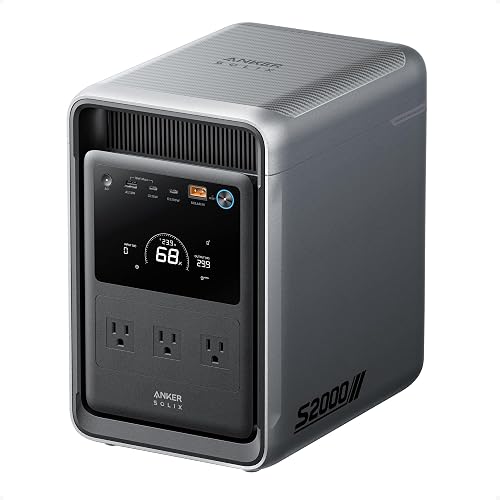
Anker SOLIX S2000 Portable Power Station: Best for basecamp power
- 2010Wh LFP
- 1500W rated, 3000W peak
- 8 outlets
- 10,000 cycles
- 35.7 lb
Two days of dish power plus fridge and lights. Anker says the LFP cells hold up through 10,000 cycles.
Pros
- Largest capacity in this group
- 10,000 charge cycles
- Under 10 ms UPS switchover
Cons
- 35.7 lb suits a vehicle, not a backpack
- No 12V DC port
The Anker SOLIX S2000 is the basecamp pick. Its 2010Wh capacity runs the dish for days without a recharge, and 1500W output with 3000W peak runs nearly every home essential in an outage.
Anker puts fridge runtime at up to 35 hours.
The 314Ah LFP cells are rated for 10,000 cycles and a 15-year lifespan. The unit sits 30% smaller and 25% lighter than the average 2kWh station at 8.2 x 11.1 x 12.7 inches.
The 6W idle draw helps it survive long stretches between uses.
Eight outlets split front and rear, and under 10 ms UPS switchover protects a home office setup. Solar input tops out at 400W, and the app supports AC plus solar charging plus a 600W silent mode.
Note there is no 12V DC port.
The trade-off is portability. At 35.7 lb it's a vehicle or cabin fixture, not a carry-on.
For a car-accessible camp that needs dish power plus fridge and lights, it's the strongest single box here. Check the energy guide label on your fridge to estimate your own runtime.
Anker SOLIX C300 DC Portable Power Station: Best USB-C only option
- 288Wh LiFePO4
- 300W output
- Two 140W USB-C ports
- 7 ports
- 6.2 lb
Runs the dish over USB-C with no AC wall involved. Small, light and made for cable-driven camps.
Pros
- Two 140W two-way USB-C ports
- LiFePO4 cells with a 3-year guarantee
- 30% smaller than similar stations
Cons
- No AC outlet
- Needs an 18W or higher USB-C charger to wake up first
The Anker SOLIX C300 DC is the USB-C route. The Starlink Mini runs on DC power, so feeding it from a 140W USB-C port skips the inverter step and saves the conversion loss.
It delivers 300W and 288Wh, or 90,000 mAh.
Two 140W two-way USB-C ports handle the dish and a laptop, plus a 120W car socket and four more USB ports. The LiFePO4 battery keeps the box small at 4.89 x 7.87 x 4.72 inches and 6.2 lb.
Anker gives a 3-year guarantee and 30% smaller size than similar stations.
The catch is activation. You must recharge it from an 18W or higher USB-C charger before first use, using the USB-C2 or USB-C3 port.
Anker also recommends its own 100W or 60W panels for solar, not the PS30 or PS200. A shoulder strap is sold separately.
There's no AC outlet, so it can't run a wall-plug appliance. If your whole kit is USB-C and you want the lightest possible dish power, this is the pick.
If you need AC for anything else, the Jackery wins.
ALLWEI Portable Power Station 300W: Best budget base unit
- 256Wh LiFePO4
- 300W with 600W surge
- MPPT solar input
- 6.4 lb
A lighter, cheaper way to run one dish and a phone. The 100W solar route refills it in 4 to 5 hours.
Pros
- 6.4 lb with a built-in handle
- MPPT solar charging
- Up to 3000 cycles claimed
Cons
- One AC outlet only
- Smaller capacity than the Jackery
The ALLWEI 300W is the budget route. At 6.4 lb and 9.25 x 5 x 6.8 inches it edges the Jackery on weight and size, and the 256Wh LiFePO4 battery runs one dish session plus a phone charge.
Output is 300W continuous with 600W peak surge and pure sine wave, so the dish sees clean power. One AC outlet means the dish and another appliance take turns, which suits a solo camper.
A 60W USB-C PD port and an 18W USB-A port cover fast phone charging.
The built-in MPPT controller helps solar charging, and ALLWEI lists 4 to 5 hours to full on a 100W panel. Dual AC plus solar input reaches full in about 2 to 2.5 hours.
A 6-layer BMS protects against shorts and overcurrent, and the cells are rated to 3000 cycles.
The trade-off is the single outlet and smaller capacity. Against the Jackery you lose an AC socket for a little less money and weight.
If your camp is one person and one dish, that's a reasonable swap.
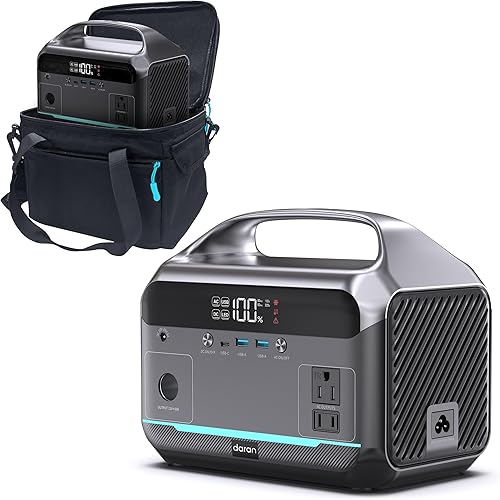
DaranEner DARAN Portable Power Station: Best for dual AC loads
- 288Wh LiFePO4
- 350W rated, 600W peak
- 2 AC outlets
- 60W USB-C
- 8.2 lb
Two AC sockets let the dish and a small appliance share the box. A 350W rating leaves room above the dish draw.
Pros
- 350W rated power
- Two AC outlets plus 60W USB-C
- BMS protection on charge and discharge
Cons
- Heavier than the ALLWEI and Jackery
- 60W USB-C tops phones slowly
The DaranEner DARAN sits between the budget and mid-range picks. Two AC outlets rated at 350W with 600W surge let the dish and a second device run together, and the 288Wh LiFePO4 battery matches the Jackery's capacity.
DaranEner lists a 0.85 conversion rate.
The 60W PD USB-C port tops a phone or tablet at a steady pace but charges a laptop slowly. That 60W class port is the main gap against the faster stations here, and the solar panels and car cable sell separately.
An advanced BMS guards against overcharge, over-discharge, short circuits and temperature swings, and the LCD shows live power draw. A rear LED works as a steady light or SOS beacon.
DaranEner says the pack supports a 30W CPAP for about 8 hours.
At 8.2 lb it's heavier than the ALLWEI and Jackery, so plan its spot in the vehicle. For a family camp where two AC sockets matter more than weight, it earns its place.
Note the maker suggests two full charge cycles before first use.
HOWEASY Portable Power Station: Best light travel backup
- 88Wh capacity
- 120W rated, 240W peak
- 8 ports
- 2.3 lb
A pocket-size reserve for short sessions. Enough for one dish boot cycle and a phone top-up, nothing more.
Pros
- 2.3 lb
- Eight output ports
- Three recharging routes
Cons
- 88Wh limits run time to short sessions
- 120W AC output caps other gear
The HOWEASY is the light travel backup. At 2.3 lb and 88Wh it fills a glovebox or daypack, and two AC sockets at 120W rated with 240W peak handle one dish boot cycle and a short session.
The body is 6.6 x 3 x 4 inches.
Eight ports cover phones, tablets and small devices, with a 5V USB port, two QC 3.0 ports and two DC ports, and a hidden handle keeps the profile slim. The LED display shows remaining power, and three lighting modes handle a dark camp.
Cycle life is rated above 1500 charges.
Recharging works from AC, a 12V car socket or a 15V to 24V solar panel of 20W to 60W. HOWEASY's own note is clear that 88Wh won't sustain a CPAP all night, so treat the same limit as applying to the dish.
The maker also suggests a couple of full cycles to calibrate the display.
The trade-off is capacity. At 88Wh it can't carry a full evening of dish use, and the 120W AC rating caps other appliances.
Treat it as an emergency reserve rather than your main station.
How these stations compare side by side
The table below lines up capacity, output and weight so you can match a station to your trip length. Bigger boxes buy runtime; lighter boxes buy distance.
| Product | Best for | Capacity | AC output | Weight | Our score |
|---|---|---|---|---|---|
| Jackery Explorer 300 Portable Power Station | overall | 292Wh | 300W (600W peak) | 7.5 lb | 9.7 |
| BLUETTI Elite 100 mini Portable Power Station | long off-grid stays | 1004.8Wh | 700W (1400W peak) | 23.5 lb | 9.6 |
| EF ECOFLOW Delta 3 Portable Power Station | expansion later | 1024Wh | 1800W | 27.6 lb | 9.5 |
| Anker SOLIX S2000 Portable Power Station | basecamp power | 2010Wh | 1500W (3000W peak) | 35.7 lb | 9.1 |
| Anker SOLIX C300 DC Portable Power Station | USB-C only option | 288Wh | 6.2 lb | 8.8 | |
| ALLWEI Portable Power Station 300W | budget base unit | 256Wh | 300W (600W peak) | 6.4 lb | 8.6 |
| DaranEner DARAN Portable Power Station | dual AC loads | 288Wh | 350W (600W peak) | 8.2 lb | 8.4 |
| HOWEASY Portable Power Station | light travel backup | 88Wh | 120W (240W peak) | 2.3 lb | 8.2 |
How we picked these stations
We compared the specs that decide whether a station runs the Starlink Mini and for how long. Output had to clear the dish draw with margin, and capacity had to suit a named trip length.
Weight, dimensions and idle draw decided which class each one lands in.
Port types mattered too. A 100W or 140W USB-C port adds a fast path for the dish or a laptop, and a car port covers travel days.
We favored LiFePO4 batteries because they hold more cycles than older chemistries, and the cycle claims range from 1500 on the HOWEASY to 10,000 on the S2000.
Solar input headroom ranked each one for off-grid use, since a panel is what turns a day trip into a week. The Delta 3 takes 500W, the S2000 400W, and the small boxes 100W or less.
Inverter ratings also split the AC units from the DC-only C300.
Our score weighs specs, features and how well each station fits what a Starlink Mini owner needs, not how many extras it ships with.
What output do you need to run the Starlink Mini?
The dish runs well under the output of every station here, so even the 120W HOWEASY covers a session. The safe rule is to pick a station rated at least double the dish's steady draw, which all eight meet except the HOWEASY at a pinch.
Output matters more when you add gear. A laptop, router or fridge pushes the total up, and the Delta 3 or S2000 open the door to appliances a 300W box can't touch.
The DaranEner's 350W rating gives a little more margin than the 300W units without the weight of the big boxes. Surge ratings tell a similar story: the 300W units peak at 600W, while the S2000 hits 3000W.
AC or DC output for the dish
The dish takes DC power, so a USB-C station like the C300 DC feeds it without an inverter. An AC station adds a conversion step and a little loss, but it also runs anything with a wall plug.
Pick AC if your camp includes a fridge or a coffee maker. Pick DC if the dish, a laptop and phones are the whole load.
The C300 DC's two 140W ports and 120W car socket cover that case without an AC outlet anywhere.
How much capacity covers a full day of dish use?
Capacity decides how many hours the dish runs, so match watt-hours to your session length. A 256Wh to 292Wh station covers an evening for most campers, and a 1004.8Wh or 1024Wh box covers a full day or more.
The 2010Wh S2000 covers several days.
If the dish sits idle between sessions, idle draw matters. The BLUETTI drops below 10W at idle and the S2000 draws 6W, so both stretch a charge across rest days.
A rough estimate uses the station's watt-hours times its conversion rate divided by the load. The DaranEner states a 0.85 rate and the HOWEASY the same figure.
The BLUETTI lists 0.77 and adds 8W for its own draw, a more honest sum.
What about solar charging on a long trip?
A panel turns any station here into a multi-day system. The Jackery reaches 80% in about 2.8 hours on 100W, and the ALLWEI takes 4 to 5 hours on the same panel size.
The HOWEASY asks for a 20W to 60W panel in the 15V to 24V range, so it fills slowly.
The Delta 3 and S2000 accept far more solar, at 500W and 400W respectively. Size the panel to the station: a small box with a big array wastes potential, while a big box with a small panel waits all day.
The BLUETTI tops out at 350W and works with third-party panels in the 12V to 60V range. A 40W panel charges the Jackery Explorer 300 to 80% in about 7.5 hours.
Do you need a pure sine wave station for the dish electronics?
Yes. The dish carries sensitive electronics, so choose a station that lists pure sine wave AC output.
The Jackery Explorer 300 and ALLWEI 300W both list it.
A modified sine wave station can heat up or unsettle delicate gear over time. None of the AC picks here cut that corner, so every one of them is a safe match for the dish.
The DC route skips the question entirely, since no inverter is involved.
Which connectors and ports fit a Starlink Mini setup?
Match the port to your cable before you buy. The dish setup uses a DC input, so a USB-C PD port or a dedicated DC cable is the cleanest route.
The C300 DC offers 140W USB-C and a 120W car socket, and the Jackery has 100W USB-C plus a 120W car port. The DaranEner carries a 60W USB-C and two DC ports, and the HOWEASY adds two 12V DC ports for small gear.
The others add AC outlets for a wall adapter.
If you plan to run the dish from a larger RV or house battery bank, the wiring question is bigger than a power station. Our guide to a RV converter charger covers charging those banks, and this piece on how many batteries for a 3000w inverter helps you size a system around a bigger inverter.
Verdict: pick the station that matches your trip
The best portable power station for Starlink Mini for a light travel kit is the Jackery Explorer 300, with enough output, a 7.5 lb body and 100W USB-C for fast top-ups. Pick the BLUETTI Elite 100 mini for multi-day stays, the Delta 3 if you want to expand later, or the SOLIX S2000 for basecamp and home backup.
The C300 DC is the choice for a pure USB-C camp, the ALLWEI wins on budget, the DaranEner when two AC sockets matter, and the HOWEASY as a pocket reserve.
Match capacity to nights, weight to how far you carry it, and port types to your cable, and the right box is obvious.
Our top 3 picks at a glance
-
1
-
2
Best for long off-grid stays
BLUETTI Elite 100 mini Portable Power Station
9.6/10 our score
See it on Amazon -
3
Best for expansion later
EF ECOFLOW Delta 3 Portable Power Station
9.5/10 our score
See it on Amazon
Frequently asked questions
What size power station does the Starlink Mini need?
The dish needs an output above its rated draw and enough watt-hours for the hours you plan to run it. Any 300W station here handles the draw.
Capacity decides run time, so a 1kWh box earns its place when you camp for days.
Can I run the Starlink Mini on DC instead of AC?
Yes. The dish runs on DC power, so a USB-C PD station like the Anker SOLIX C300 DC can feed it without an inverter step.
Check the exact connector your setup uses before you commit to a cable.
How long will a power station run the Starlink Mini?
Estimate it from the station's watt-hours and the dish's draw. A 292Wh unit covers short sessions, while a 1004.8Wh unit like the BLUETTI Elite 100 mini carries multi-day trips.
Cold nights cut run time, so pack capacity margin.
Can a power station recharge the Starlink Mini and itself at once?
The Jackery Explorer 300 and the ALLWEI 300W both support pass-through charging. A solar panel can top up the station while the dish runs from it, which stretches a sunny trip considerably.
Do I need pure sine wave output for the Starlink Mini?
Yes. The dish has sensitive electronics, so choose a station with pure sine wave AC.
The Jackery and ALLWEI both list pure sine wave output, which protects the dish and your laptop alike.
What is the best portable power station for Starlink Mini on a strict budget?
The ALLWEI 300W delivers the lowest cost per watt-hour in this group. It powers one dish from a single outlet and refills in 4 to 5 hours on a 100W panel.
Accept the smaller capacity for short trips.


