8 Best Portable Power Stations With Solar Panels (November 2026)
The best portable power stations with solar panels include the Jackery Explorer 300 Portable Power Station for light hiking and weekend trips, the Anker SOLIX C1000 Gen 2 Portable Power for home backup and big loads, and the MARBERO 237Wh Solar Generator with Solar Panel (best budget set for tent camping).
On this page (5 sections)
The best portable power station with solar panels for most people is the Jackery Explorer 300, a 7.1 lb unit with LiFePO4 cells rated for more than 4,000 cycles. Pair it with a separate 100W panel and it reaches 80% in about 2.8 hours.
For home backup and heavy loads, the Anker SOLIX C1000 Gen 2 ships with a 200W panel and runs 2,000W of appliances.
Solar-ready power stations split into two groups. Small sets of 220Wh to 300Wh fit in a backpack and charge phones, cameras and a CPAP machine.
Larger units of 1,000Wh and up ship with bigger panels and can run a fridge or a campsite.
Deciding between them starts with the load, not the battery size. A 300W station cannot start a coffee maker no matter how much sun it collects.
Our guide to how much solar you need for an RV works through the same math for a van or trailer.
Our picks at a glance
-
1
 Best for light hiking and weekend trips
Jackery Explorer 300 Portable Power Station
9.7/10 our score
See it on Amazon -
2
 Best for home backup and big loads
Anker SOLIX C1000 Gen 2 Portable Power
9.6/10 our score
See it on Amazon -
3
 Best budget set for tent camping
MARBERO 237Wh Solar Generator with Solar Panel
9.5/10 our score
See it on Amazon
- 4
 Check it
Anker SOLIX C300 DC Portable Power Station
Best for USB-C gear and phones - 5
 Check it
Takki Solar Generator Peak 450W Portable Power
Best for CPAP and small fridges - 6
 Best all-in-one with a built-in panelCheck it
- 7
 Check it
EF ECOFLOW DELTA 3 MAX Portable Power
Best for running a whole campsite - 8
 Check it
MARBERO Solar Generator 296Wh with Solar Panels
Best for charging a family's devices
The best portable power stations with solar panels, ranked
The top pick wins on weight and battery life, but each station here answers a different job. Read the write-ups for the load each one can actually carry, then pick by how you'll use it.
Jackery Explorer 300 Portable Power Station: Best for light hiking and weekend trips
- 292Wh LiFePO4 battery
- 300W output, 600W peak
- 7.1 lb with integrated handle
- 2 AC outlets and a 100W USB-C PD port
Light enough to carry on a day hike yet able to run a laptop or CPAP machine. Solar panels are sold separately, so plan for the extra panel.
Pros
- Very light for its capacity
- LiFePO4 cells rated for over 4,000 cycles
- Six output ports for its size
Cons
- Solar panel not included
- 300W limit rules out most kitchen appliances
The Jackery Explorer 300 is the pick for anyone who walks to their campsite. At 7.1 lb it is light enough for a day pack, and the integrated handle means no separate carry case.
The 292Wh battery runs a 300W load, with a 600W peak for short surges. Two AC outlets, a 100W USB-C PD port, two USB-A ports and a 120W car port cover a laptop, a drone and a phone at the same time.
Jackery suggests the formula 300Wh x 0.85 divided by your device's watts for runtime, which puts a 60W laptop at about 4.3 hours. The plastic enclosure keeps that weight down, and the compact form factor slips into a pack beside a sleeping bag.
Its LiFePO4 cells are the standout. Jackery rates them for more than 4,000 cycles before 70% capacity, roughly 11 years of regular use.
Charging is quick when the sun cooperates: 80% in about 2.8 hours on a 100W panel, or 80% in 7.5 hours from a 40W panel. It can also charge devices while it is being recharged, and AC tops it up in about 3 hours.
The trade-off is that the panel costs extra, and the 300W ceiling rules out kettles and most cooking gear. For a light hiker who wants a decade of use from one battery, neither matters much.
Anker SOLIX C1000 Gen 2 Portable Power: Best for home backup and big loads
- 1,024Wh LiFePO4 battery
- 2,000W output, 3,000W peak
- Ships with a 200W bifacial solar panel
- 10 ms UPS switchover
A whole-home backup unit with a matching solar panel in the box. The 2,000W output runs fridges and power tools that smaller stations cannot touch.
Pros
- Panel included in the bundle
- Runs high-draw appliances
- 10 ms UPS switchover for sensitive gear
Cons
- Much heavier and bulkier than the small picks
- No battery expansion
The Anker SOLIX C1000 Gen 2 is the pick when the load is big and the sun is the fuel. It arrives as two packages: the 1,024Wh station and a 200W bifacial solar panel.
Anker says 600W of solar refills it fully in 1.8 hours.
The 2,000W output and 3,000W peak run what the small stations cannot: a home fridge, a microwave, power tools. Anker quotes a 10 ms UPS switchover, so a desktop or a CPAP machine keeps running through a brief outage.
Nine ports spread that output across AC, DC and USB connections.
Anker rates the LiFePO4 battery for 4,000 cycles at 80% capacity, about 10 years of daily use. Time-of-Use mode in the Anker app schedules charging to cheaper hours if you keep it plugged in at home.
A 49-minute full AC recharge via HyperFlash also makes it usable as a daily backup, though Anker notes the speed needs cell temperature above 20 °C.
Two limits stand out. It weighs far more than the backpack picks, and Anker dropped battery expansion on this model to save size.
For a home or car-camp setup where it rarely moves, neither is a problem.
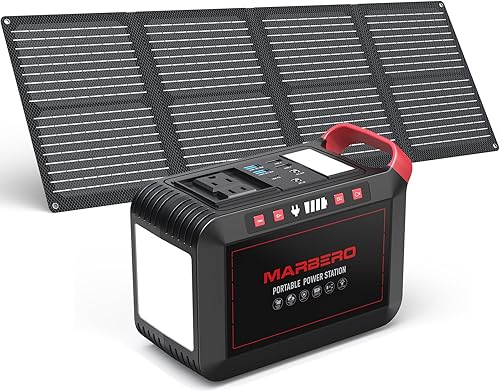
MARBERO 237Wh Solar Generator with Solar Panel: Best budget set for tent camping
- 237Wh battery
- 300W pure sine wave output
- 60W folding panel included
- Built-in flashlight with SOS mode
One box with the station and a folding solar panel, priced as a set. Pure sine wave AC suits laptops and phones that dislike modified wave power.
Pros
- Solar panel in the box
- Pure sine wave AC outlets
- Flashlight and SOS mode built in
Cons
- 9 lb is heavier than the lightest pick
- Not built for appliances over 300W
The MARBERO 237Wh is the best value set for tent camping. The station and a 60W folding solar panel come together, so there's no second purchase before your first trip.
The set is a single kit from a brand built around affordable solar gear.
Its two AC outlets deliver pure sine wave power at 300W rated and 375W peak. That waveform suits laptops, cameras and CPAP machines better than the modified sine wave found on cheap units.
A 2-prong and a 3-prong outlet are both present, plus two USB-A QC3.0 ports, two standard USB-A ports, a USB-C PD port and a 12V DC output.
MARBERO lists the panel at 21.5 to 23.5% conversion efficiency, and a smart chip adjusts output to the device being charged. A three-mode flashlight (steady, strobe, SOS) adds a safety tool you'd otherwise pack separately.
The 12V DC port takes a car cooler cable directly.
At 9 lb it is heavier than the Takki and the smaller MARBERO, and the 300W ceiling keeps it away from heaters. For a first solar set that runs a laptop and phones from the sun, the price-to-capability balance is the strongest here.
Anker SOLIX C300 DC Portable Power Station: Best for USB-C gear and phones
- 288Wh LiFePO4 battery
- 300W output
- Two 140W two-way USB-C ports
- Ships with a 60W solar panel
Built around USB-C rather than wall outlets. It fills laptops and cameras fast from two 140W ports and comes with a 60W folding panel.
Pros
- Very fast USB-C charging
- Solar panel in the box
- Small footprint at 4.88 x 4.72 x 7.87 in
Cons
- No standard AC outlet
- Does not accept Anker PS200 or PS400 panels
The Anker SOLIX C300 DC is for people whose gear charges over USB-C. It has no standard AC outlet at all, but two 140W two-way USB-C ports fill a laptop in the time a wall charger would.
The 288Wh LiFePO4 battery and 300W output cover a camera kit or a tablet plus phone through a weekend. A 60W solar panel comes in the box, and Anker says it reaches 80% in about 4 hours on that panel.
AC charging hits 80% in 50 minutes. A 120W car socket, a 100W USB-C port and two 12W USB-A ports round out seven charging options.
Its 4.88 x 4.72 x 7.87 in body is the most compact in this group, and Anker says it is 30% smaller than similar stations. A shoulder strap is sold separately.
Anker's warning matters here: it does not accept the PS30, PS200 or PS400 panels, so buy panels from the supported 11V to 28V range.
If your load is all USB-C, this is the neatest station to carry. If you need a wall plug for a fan or a lamp, look at the Jackery or MARBERO sets instead.
Takki Solar Generator Peak 450W Portable Power: Best for CPAP and small fridges
- 222Wh battery
- 250W rated, 450W peak output
- 60W solar panel set included
- Two-level brightness light panel
The lightest solar set here and one of the few with a peak rating well above its running watts. Takki says it runs a CPAP machine or a mini car fridge for about 3 hours.
Pros
- Lightest set in this group
- Pure sine wave AC output
- Solar panel and light panel included
Cons
- 250W running limit is the lowest here
- Short runtime on larger loads
The Takki set is for CPAP users and small-fridge campers who want to keep weight down. At 5.95 lb for the station plus 1.87 lb for the panel, it is the lightest set here.
The station body measures just 8.13 x 4.35 x 5.93 in.
Takki rates the output at 250W running and 450W peak. The peak figure is what matters for a compressor or a motor: a mini car fridge can start on 450W even though it only needs a couple hundred watts to keep running.
Takki says the unit runs a mini car fridge or a CPAP machine for about 3 hours, and lists a 17+ smartphone charge count.
The 222Wh battery pairs with an included 60W panel that folds to 8.11 x 10.7 in. Takki says AC charging reaches 80% in 4 hours and a full charge in 6 to 7 hours.
A two-level light panel and an SOS mode make it useful as an emergency lamp as well as a power bank. A BMS handles voltage and temperature control.
The 250W running limit is the lowest in this group, so leave kettles and space heaters out. For a light pack and a CPAP machine, the low weight and the high peak rating make it the smarter carry.
BROWEY 1600W: Best all-in-one with a built-in panel
- 1,024Wh LiFePO4 battery
- 1,600W output, 3,200W peak
- Built-in 40W solar panel
- 8 output ports including USB-C PD 100W
The only station here with a solar panel built into the case. Fold it out in camp and charge without carrying a separate panel.
Pros
- Panel folds into the unit
- High 1,600W output
- BROWEY says 3,000+ cycles to 80%
Cons
- 26 lb makes it a car-camp unit, not a hiking one
- 40W built-in panel is slow to refill 1,024Wh
The BROWEY 1600W is the only station here with a solar panel built into its case. Flip out the 40W panel at camp and charge without unpacking anything extra.
BROWEY won an iF Design Award 2022 for the design, and the built-in MPPT controller manages the solar input.
The 1,024Wh LiFePO4 battery and 1,600W output (3,200W peak) run a fridge, a CPAP machine or power tools. Eight ports include a USB-C PD 100W and DC outputs with ten adapter plugs.
BROWEY says 3,000+ cycles to 80% capacity, so about 10 years of daily use. Its BMS guards against overvoltage, overheating and short circuits.
The built-in panel is handy but slow: 40W will take many hours to refill 1,024Wh. BROWEY says the unit can also connect to larger panels, which is the better route for daily charging.
AC and USB-C together reach 80% in 3 hours. The flat case measures 13.3 x 17.1 x 5.5 in.
At 26 lb this is a car-camp or cabin unit. Pick it if you want one box and no separate panel to lose; pick the Anker C1000 Gen 2 if panel speed matters more than the all-in-one build.
EF ECOFLOW DELTA 3 MAX Portable Power: Best for running a whole campsite
- 2,048Wh LiFePO4 battery
- 2,400W output, 3,400W X-Boost
- Ships with a 220W solar panel
- 10 ms transfer time
The largest battery and the highest output in this group, paired with a 220W bifacial panel. It suits a family campsite or a fridge at home during outages.
Pros
- Biggest capacity here
- X-Boost handles 99% of appliances, EcoFlow says
- 220W panel in the box
Cons
- Heavy and expensive for casual campers
- Only 3 AC outlets for its output
The EF ECOFLOW DELTA 3 MAX is the largest and most powerful set here. Its 2,048Wh LiFePO4 battery pairs with a 220W bifacial panel, and EcoFlow's X-Boost mode pushes continuous output to 3,400W for high-demand appliances.
EcoFlow says X-Boost covers 99% of appliances, which includes fridges, microwaves and power tools. A 10 ms transfer time keeps computers and medical devices safe during a home outage.
AC charging goes from 0 to 80% in 1.13 hours, so it can be topped up quickly before a storm. The unit also runs quietly enough for a bedroom during an outage.
The LiFePO4 battery is built for 10 years of daily use, and EcoFlow backs the unit with a 5-year service term. The EcoFlow app shows real-time energy use and lets you set charging schedules to cut costs.
The case measures 19.5 x 9.4 x 12 in and runs on aluminum and plastic.
The case against it is weight and outlet count: only 3 AC outlets for all that output, and it is the heaviest unit in this group. For a family campsite or a whole-home backup, the capacity makes up for the bulk.
For weekend hikes, it stays home.
MARBERO Solar Generator 296Wh with Solar Panels: Best for charging a family's devices
- 296Wh battery
- 300W pure sine wave output
- 60W IP65 waterproof panel included
- 8 ports including two AC outlets
Eight ports let one station top up several phones, tablets and a laptop at once. The folding panel carries an IP65 waterproof rating for damp camp mornings.
Pros
- Most ports in this group
- Light 5.73 lb station
- IP65 panel handles light rain
Cons
- 300W output caps what it can run
- Li-ion cells rated for 1,000 cycles, not LiFePO4
The MARBERO 296Wh set is the pick for charging several devices at once. Eight ports cover two AC outlets (2-prong and 3-prong), three USB-A, one USB-C PD 18W and two 12V DC ports, enough for a family's phones, tablets and a laptop without cable swapping.
The 296Wh battery delivers 300W pure sine wave AC. MARBERO says it charges an iPhone 15 up to 15 times or a 13-inch laptop 4 times, and a 10W LED camping light for 20 straight hours.
The included 60W panel folds to 10.15 x 13.93 x 1.18 in and carries an IP65 waterproof rating, so light rain does not stop it. Its conversion efficiency reaches 23%.
The station weighs 5.73 lb and the panel 3.08 lb, which keeps the set in backpack range. A built-in BMS guards against overcharge, overheating and short circuits.
The shell is built to shrug off drops and scratches, and the LED flashlight adds SOS mode.
Its Li-ion cells are rated for 1,000 cycles to 90% capacity, a shorter life than the LiFePO4 units here. And 300W still caps the appliances.
For device-heavy trips where port count matters more than battery chemistry, it earns its place.
How these solar power stations compare
The table lines up the specs that decide which set fits your trip: battery capacity, output, weight and what comes in the box. Start with the load you plan to run, then use capacity and panel size to estimate recharge time.
| Product | Best for | Capacity | Output | Weight | Our score |
|---|---|---|---|---|---|
| Jackery Explorer 300 Portable Power Station | light hiking and weekend trips | 292Wh | 300W rated, 600W peak | 7.1 lb | 9.7 |
| Anker SOLIX C1000 Gen 2 Portable Power | home backup and big loads | 1,024Wh | 2,000W, 3,000W peak | 9.6 | |
| MARBERO 237Wh Solar Generator with Solar Panel | budget set for tent camping | 237Wh | 300W rated, 375W peak | 9 lb | 9.5 |
| Anker SOLIX C300 DC Portable Power Station | USB-C gear and phones | 288Wh | 300W | 6.2 lb | 9.1 |
| Takki Solar Generator Peak 450W Portable Power | CPAP and small fridges | 222Wh | 250W rated, 450W peak | 5.95 lb | 8.9 |
| BROWEY 1600W | all-in-one with a built-in panel | 1,024Wh | 1,600W, 3,200W peak | 26 lb | 8.7 |
| EF ECOFLOW DELTA 3 MAX Portable Power | running a whole campsite | 2,048Wh | 2,400W, 3,400W X-Boost | 8.4 | |
| MARBERO Solar Generator 296Wh with Solar Panels | charging a family's devices | 296Wh | 300W | 5.73 lb station | 8.2 |
Our score weighs specs, features and buyer feedback against what you're shopping for. A station that carries a laptop for a weekend earns more than a heavier unit with more capacity you never use.
That is why the light Jackery tops the list while the DELTA 3 MAX sits lower despite its size. Panel size counts too: a set with a panel in the box saves both a purchase and a compatibility check.
How we compared these portable power stations with solar panels
We checked the specs on each product and scored them against the job a solar shopper needs done. Four things carried the most weight.
What's in the box. A set with a panel included saves a purchase and a compatibility question.
Seven picks ship with a panel; the Jackery does not.
Battery chemistry and cycle life. LiFePO4 cells (Jackery, Anker, BROWEY, EcoFlow) are rated for 3,000 to 4,000 cycles.
The MARBERO 296Wh uses Li-ion rated for 1,000 cycles.
Over a decade of camping, that gap matters more than a few watt-hours.
Load ceiling. The rated watts set what a station can run all day.
The peak watts only cover a surge.
A 250W unit with a 450W peak can start a small fridge but cannot run a heater.
Weight against capacity. Every extra pound is one you carry from the car to the tent.
The 7.1 lb Jackery and the 26 lb BROWEY serve different trips even though both are solar-ready.
The lightest station here, the MARBERO 296Wh at 5.73 lb, shows how far small-cell designs have come.
What should you check before buying a solar power station?
Check three numbers first: the watts your device needs to run, the watt-hours it uses in a day, and the solar input range the station accepts. A station that fits all three will actually recharge from the sun you have.
How do you size the battery to your devices?
Add up the running watts of everything you'll plug in at once. That total must stay under the station's rated output.
Then multiply each device's watts by the hours it runs per day to get watt-hours.
A 60W laptop for 4 hours is 240Wh. That already exceeds the 222Wh Takki and comes close to the 237Wh MARBERO.
For a laptop-heavy trip, start at 300Wh and expect to top up from solar each afternoon. The 292Wh Jackery leaves a little headroom for a phone alongside the laptop.
What solar panel size matches each station?
Divide the battery capacity by the panel's real output, then add time for clouds and shade. Anker says its C1000 Gen 2 refills fully in 1.8 hours on 600W of solar.
A 60W panel on a 300Wh station takes roughly 5 to 6 hours in full sun. A 40W panel on the BROWEY's 1,024Wh battery would take most of a sunny day and then some.
Panels rarely hit their rated watts. A 100W panel might deliver 70W to 80W in good light.
Size the panel for the cloudy day, not the perfect one. For a multi-day trip off grid, aim for a panel whose rated watts are at least a third of the battery's watt-hours.
Does solar input voltage have to match the panel?
Yes. Each station lists a solar input voltage range, and a panel outside it won't charge safely.
The Anker C300 DC takes panels from 11V to 28V and rejects the PS30, PS200 and PS400 models. BROWEY's station uses a 5.5mm x 2.1mm DC input and works with any panel through its ten adapters.
The MARBERO 296Wh set pairs its own 60W panel over DC.
Which station runs a fridge or a CPAP machine?
A fridge needs a station that can cover its startup surge. The Takki's 450W peak and the Anker C1000 Gen 2's 2,000W output both handle small fridges.
For a CPAP machine, look at the 10 ms UPS switchover on the Anker and EcoFlow units so a brief outage doesn't wake the user. Takki rates its unit for about 3 hours on a CPAP machine.
If you're building a bigger solar setup around an inverter, our roundup of the best 3000 watt inverter for RV use covers the next step up. And if you're adding solar to a van's built-in system, an RV converter charger keeps the house battery topped up from shore power.
How should you store and charge the station between trips?
Keep the battery between about 30% and 80% when it sits for months. A full charge left in a hot garage shortens the life of any lithium cell.
Top it up every few months so it doesn't drop to zero.
Charge from solar when you can, but use AC before a trip if the forecast is cloudy. And keep the panel facing the sun at a 90-degree angle for the best output.
Shade on even part of a panel cuts its watts more than most people expect. The folding panels here all need full unfolding to reach their rated output, so set them up flat and clear of tent shadows.
Verdict: which solar power station should you buy?
The best portable power station with solar panels for most buyers is the Jackery Explorer 300 if you carry your gear and want a decade of use from a light battery. Pick the Anker SOLIX C1000 Gen 2 when you need 2,000W and a panel in the box for home backup.
Choose the MARBERO 237Wh set for a cheap first solar kit, the Takki for a light CPAP setup, or the DELTA 3 MAX when a family campsite needs whole-home scale.
If you're powering a Starlink dish off-grid, our guide to the best portable power station for Starlink Mini matches capacity to that draw. Match the panel to your sun and the station to your load, and the set will earn its weight on every trip.
Our top 3 picks at a glance
-
1
Best for light hiking and weekend trips
Jackery Explorer 300 Portable Power Station
9.7/10 our score
See it on Amazon -
2
Best for home backup and big loads
Anker SOLIX C1000 Gen 2 Portable Power
9.6/10 our score
See it on Amazon -
3
Best budget set for tent camping
MARBERO 237Wh Solar Generator with Solar Panel
9.5/10 our score
See it on Amazon
Frequently asked questions
What size portable power station do I need with solar panels?
For phones and a laptop, 200Wh to 300Wh is enough for a weekend. For a fridge or home backup, start at 1,000Wh.
Add up the watt-hours your devices use per day, then pick a station and panel that can replace that amount of charge each sunny day.
Can I leave a solar panel charging a power station all day?
Yes, as long as the panel's voltage falls inside the station's solar input range. Panels with a smart chip or the station's own charge controller stop the flow once the battery is full.
Keep the panel out of deep shade so it keeps a steady charge.
How long does it take to charge a power station with a solar panel?
Divide the battery capacity by the panel's real-world output. Anker says its C1000 Gen 2 refills fully in 1.8 hours on 600W of solar.
A 60W panel on a 300Wh station takes far longer, and clouds cut output below the rated watts.
Do I need a separate charge controller with a solar panel?
Not when the panel plugs straight into the station's solar input. These stations have built-in charge control.
A separate controller only matters when you build your own panel array from loose panels without one.
What is the difference between rated watts and peak watts?
Rated watts are what a station supplies all day. Peak watts cover a brief surge when a motor or compressor starts.
A 250W station with a 450W peak can start a small fridge it could not run continuously above 250W.


