9 Best Camco RV Surge Protector Options for Your Rig (November 2026)
The best Camco RV surge protector choices include the GEARGO RV Surge Protectors 30 Amp RV for most 30 amp campers, the Progressive Industries SSP-50XL Portable RV Smart Surge for 50 amp plug-in setups, and the GEARGO 𝟐𝟎𝟐𝟔 Smart RV Surge Protector 30 for voltage monitoring.
On this page (10 sections)
- Camco RV surge protector choices at a glance
- Which protectors fit a camco rv surge protector search
- How these were compared
- Should you buy 30 amp or 50 amp for your rig?
- Does a circuit analyzer matter as much as joules?
- Do you need a full EMS instead of a basic surge protector?
- Can you hardwire a protector instead of using a plug-in?
- How we pick among the 30 amp options
- Does a 50 amp rig need more protection than a 30 amp one?
- Verdict
The best pick for most 30 amp campers here is the GEARGO 30 Amp RV Surge Protector, a 12,000-joule unit with a full circuit analyzer and a waterproof cover. If your rig runs a 50 amp pedestal, the Progressive Industries SSP-50XL is the cleaner plug-in choice.
One thing to settle first: Camco is known for hoses, levelers and sewer gear, and our data didn't have a Camco-branded surge protector to rank. So this roundup covers the protectors that fit the same 30 and 50 amp hookups a Camco shopper is buying for.
Every pick below protects your camper's electronics from bad park power. They differ in how much surge they absorb, whether they check the pedestal wiring, and whether they cut power when voltage drifts.
Our picks at a glance
-
1
-
2
 Best for 50 amp plug-in setups
Progressive Industries SSP-50XL Portable RV Smart Surge
9.6/10 our score
See it on Amazon -
3
 Best for voltage monitoring
GEARGO 𝟐𝟎𝟐𝟔 Smart RV Surge Protector 30
9.5/10 our score
See it on Amazon
- 4
 Check it
GEARGO RV Surge Protectors 50 Amp
Best for 50 amp power spikes - 5
 Check it
Progressive Industries EMS-PT30X (30 Amp)
Best full EMS for 30 amp rigs - 6
 Check it
GEARGO 𝟑𝐫𝐝-𝐆𝐞𝐧 RV Surge Protector 50 Amp
Best high-joule 50 amp value - 7
 Check it
Power Watchdog PWD30 (30 Amp, Bluetooth)
Best for phone monitoring - 8
 Check it
Southwire Surge Guard 30 Amp Portable
Best budget 30 amp choice - 9
 Check it
Progressive Industries SSP-30XL (30 Amp)
Best simple plug-in for travel trailers
Camco RV surge protector choices at a glance
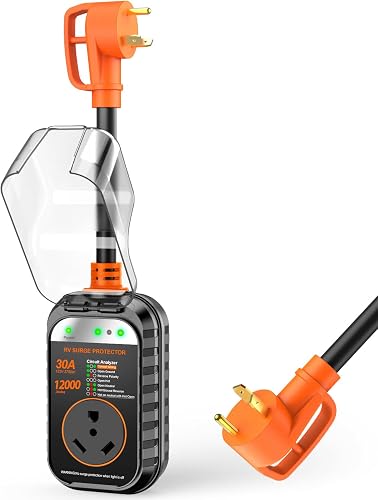
GEARGO RV Surge Protectors 30 Amp RV: Best for most 30 amp campers
- 12,000 joules
- Circuit analyzer
- IP68 waterproof cover
- Right-angle male plug
A 30 amp protector with a full circuit analyzer and a heavy waterproof shell, which covers the common 30 amp pedestal.
Pros
- 12,000 joules
- Circuit analyzer for six fault types
- IP68 cover handles rain and dust
Cons
- No digital voltage readout
- Not a full EMS with auto shutoff
Progressive Industries SSP-50XL Portable RV Smart Surge: Best for 50 amp plug-in setups
- 50 amp, 120-240 V
- 1,650 joules
- All weather shield
- Made in USA
A portable 50 amp protector with fault detection and a weather shield, built for big rigs and dual air conditioners.
Pros
- Handles full 50 amp service
- Detects open ground, neutral and reverse polarity
- Weather shield and thermal protection
Cons
- Lower joule rating than the GEARGO units
- Only 50 amp, no 30 amp use
GEARGO 𝟐𝟎𝟐𝟔 Smart RV Surge Protector 30: Best for voltage monitoring
- 16,000 joules
- Real-time LED display
- Auto shutoff below 103 V or above 132 V
- IP68 cover
The strongest 30 amp protector here on joules, with a screen that shows live voltage and an auto shutoff when power drifts out of range.
Pros
- 16,000 joules
- Live LED voltage display
- Auto cut off and reset
Cons
- Higher price than the basic 30 amp pick
- 30 amp only
GEARGO RV Surge Protectors 50 Amp: Best for 50 amp power spikes
- 15,000 joules
- 50 amp circuit analyzer
- IP68 waterproof
- Right-angle plug
A 50 amp protector with a big joule rating and a circuit analyzer, for rigs running two air conditioners on a 50 amp pedestal.
Pros
- 15,000 joules for 50 amp service
- Circuit analyzer for six fault types
- IP68 shell
Cons
- No digital display
- 50 amp only
Progressive Industries EMS-PT30X (30 Amp): Best full EMS for 30 amp rigs
- 30 amp, 120 V
- 1,790 joules
- EMS with over and under voltage protection
- Accidental 240 V protection
A full electrical management system that guards against low and high voltage, miswiring and accidental 240 V on a 30 amp hookup.
Pros
- Full EMS protection, not just surges
- Accidental 240 V protection
- Made in USA
Cons
- Lower joule rating
- Higher price than a basic protector
GEARGO 𝟑𝐫𝐝-𝐆𝐞𝐧 RV Surge Protector 50 Amp: Best high-joule 50 amp value
- 18,000 joules
- Circuit analyzer with LED indicators
- IP68 waterproof
- Plug and play
The highest joule rating in this group, aimed at 50 amp rigs that want maximum surge headroom without stepping up to a full EMS.
Pros
- 18,000 joules, the most here
- LED fault indicators
- Tool-free install
Cons
- No EMS voltage cutoff
- 50 amp only
Power Watchdog PWD30 (30 Amp, Bluetooth): Best for phone monitoring
- 3,000 joules
- Bluetooth app monitoring
- Customizable alert thresholds
- Replaceable surge module
A smart 30 amp protector that shows live park power on your phone and lets you set your own warning limits.
Pros
- Live voltage, amps and watts on your phone
- Custom thresholds
- Replaceable surge module
Cons
- Lower joule rating than the high-joule picks here
- Needs the app to get full use
Southwire Surge Guard 30 Amp Portable: Best budget 30 amp choice
- 2,100 joules
- Enhanced diagnostics
- Easy-T-Pull handle
- Anti-theft lock ring
A simple, light 30 amp protector for pop-ups and small trailers that want fault checking without paying for extra features.
Pros
- Light and easy to handle
- Fault diagnostics
- Lock ring deters theft
Cons
- 2,100 joules
- No voltage cutoff
Progressive Industries SSP-30XL (30 Amp): Best simple plug-in for travel trailers
- 30 amp, 120 V
- 825 joules
- Fault detection
- All weather shield
The lightest-duty pick here, a plug-in 30 amp protector that checks wiring faults and adds a basic surge buffer for small campers.
Pros
- Small and light
- Open ground and polarity detection
- Weather shield
Cons
- 825 joules, the lowest here
- Limited surge capacity for big loads
Which protectors fit a camco rv surge protector search
Most RVers searching for a camco rv surge protector need a plug-in unit for a 30 amp or 50 amp pedestal. The picks below cover both services, ordered by score.
Start with the GEARGO 30 amp for a balanced mix of surge capacity, fault checking and price. The 30 amp group covers most travel trailers and smaller motorhomes.
The 50 amp group is for big rigs and dual air conditioner setups.
The 30 amp campers in this group all plug into the same NEMA TT-30 style outlet that shows up at most state parks and private campgrounds. The 50 amp units use the larger four-prong plug that carries 120-240 V service.
Getting the plug shape right matters before you look at joules, because the wrong unit simply won't fit the pedestal you booked.
A few picks add extras like live voltage display, phone monitoring or a full EMS cutoff. If you're still not sure what these devices actually do, our explainer on what an RV surge protector does walks through surges, low voltage and miswired pedestals.
| Product | Best for | Amperage | Surge rating | Weather rating | Our score |
|---|---|---|---|---|---|
| GEARGO RV Surge Protectors 30 Amp RV | most 30 amp campers | 30 A | 12,000 joules | IP68 | 9.7 |
| Progressive Industries SSP-50XL Portable RV Smart Surge | 50 amp plug-in setups | 50 A | 1,650 joules | 9.6 | |
| GEARGO 𝟐𝟎𝟐𝟔 Smart RV Surge Protector 30 | voltage monitoring | 30 A | 16,000 joules | 9.5 | |
| GEARGO RV Surge Protectors 50 Amp | 50 amp power spikes | 50 A | 15,000 joules | IP68 | 9.5 |
| Progressive Industries EMS-PT30X (30 Amp) | full EMS for 30 amp rigs | 30 A | 1,790 joules | 9.3 | |
| GEARGO 𝟑𝐫𝐝-𝐆𝐞𝐧 RV Surge Protector 50 Amp | high-joule 50 amp value | 50 A | 18,000 joules | IP68 | 9.2 |
| Power Watchdog PWD30 (30 Amp, Bluetooth) | phone monitoring | 30 A | 3,000 joules | 8.8 | |
| Southwire Surge Guard 30 Amp Portable | budget 30 amp choice | 30 A | 2,100 joules | 8.3 | |
| Progressive Industries SSP-30XL (30 Amp) | simple plug-in for travel trailers | 30 A | 825 joules | 7.8 |
How these were compared
We checked the specs for each unit: amperage, joule rating, fault detection, weather sealing and any auto cutoff. Then we weighed how each one fits a real hookup.
Our score weighs specs, features and how well each product suits the common 30 and 50 amp camper. A protector with a full EMS, a bigger joule rating or a live readout earns more than a basic spike absorber.
We didn't test these units; the rankings come from the published specs and the jobs they solve.
The joule number got the most weight, but not by itself. A 20,000-joule unit that only stops spikes loses points against a 1,700-joule unit that also cuts power on low voltage.
The same goes for weather sealing: an IP68 cover matters if you camp in rain or dust, but a unit that only works in fair weather is not a camping tool.
Fault detection carried real weight too. Every unit here checks the pedestal, but the GEARGO and Southwire models list the full set of faults they flag, which is more useful than a single indicator light.
We scored the Progressive Industries EMS-PT30X high despite its modest joules because its voltage protection does a job the big-joule units skip.
The service life of the unit also counted. A protector that absorbs a big hit and then dies leaves you with a paperweight unless the unit warns you first.
That's why the surge failure indicator on the Progressive units matters, and why the Power Watchdog's replaceable surge module earns credit even with a smaller joule rating.
The joule rating and what it means
Joules measure how much energy a protector can soak up in a single surge. A lightning strike near a campground or a faulty pedestal can send a spike down the cord, and the protector turns that energy into heat instead of passing it to your appliances.
The ratings here run from 825 joules to 18,000 joules. A bigger number means more headroom before the unit gives out.
That does not mean you should ignore the smaller units, but it does mean the 50 amp rigs with more electronics to protect get more benefit from the big-joule models.
A unit's rating is a fixed ceiling, not a countdown, so a 12,000-joule unit simply has more capacity than an 825-joule one when a large spike arrives.
That matters at parks with unstable power, where a unit may soak up dozens of small blips in a single summer.
The weather rating and the shell
An IP68 cover is sealed against dust and against being dunked in water. The GEARGO units all carry IP68.
The Progressive Industries units use an all-weather shield assembly and Lexan housing instead of an IP number. The Power Watchdog lists IP65, which handles rain and splashes but not full immersion.
The Southwire uses a nylon enclosure with no water rating.
The enclosure material matters as much as the seal. Polycarbonate and Lexan housings shrug off sun and temperature swings better than soft plastic.
A unit left plugged in through a rainy week at the shore needs a cover that won't split, and a nylon or polycarbonate shell holds up better than a thin one.
The fault chart each unit shows
The circuit analyzers flag the common pedestal problems: correct wiring, open ground, open neutral, reverse polarity, hot and ground reversed, and no power. A unit that only shows a power light won't tell you the outlet is miswired until your electronics pay for it.
The fault chart is the part you check before you plug in.
Read the chart before the RV cord goes in. If the light pattern says open neutral or reverse polarity, leave the rig unplugged and ask the office for another site.
A correctly wired pedestal shows the safe pattern and nothing else.
The plug shape and the handle
The GEARGO 30 and 50 amp units use ergonomic power grip handles and a right-angle male connector. The angle keeps the cord from bending sharply at the pedestal, which is easier on the plug over a season of hookups.
The Southwire uses an Easy-T-Pull handle with the receptacle built into it. The Progressive units add a rugged pull handle so you can unplug without yanking on the cord.
The handle matters more than it sounds. Pulling a stiff plug out of a worn pedestal by the cord stresses the connections inside the unit.
A handle lets you pull straight out and keep the plug body intact.
Should you buy 30 amp or 50 amp for your rig?
Buy a 30 amp protector if your camper has a 30 amp main inlet, and a 50 amp protector if it carries a 50 amp cord. The protector should sit on the same service your rig uses most often.
The reason is simple. A 30 amp protector is built around a 120 V, 30 A hookup and the 30 amp plug shape.
A 50 amp unit covers 120-240 V and the heavier plug a big rig needs.
An adapter changes the plug shape, but the protector still needs to match the current it will pass. That's why matching the service matters more than matching the brand name on the box.
When a 30 amp unit is enough
A travel trailer, pop-up or small motorhome with one air conditioner usually runs on 30 amp service. The GEARGO 30 amp picks and the Southwire Surge Guard fit that setup.
The 30 amp units are also the easier ones to carry. The Southwire is the lightest of the group and the SSP-30XL is only a bit heavier.
A 50 amp unit runs closer to 3 pounds and takes up more room in the bay.
The smaller service also draws less current, so a spike on a 30 amp hookup carries less energy into the rig than the same spike on a 50 amp feed. That's why a 12,000-joule unit like the GEARGO 30 amp is a sensible match for a single air conditioner camper, while the 50 amp units are built for the heavier loads.
When you step up to 50 amp
A fifth wheel or diesel pusher with two air conditioners and a 50 amp inlet needs a 50 amp protector. The Progressive Industries SSP-50XL and the GEARGO 50 amp units are built for that service.
If you sometimes plug a 50 amp rig into a 30 amp pedestal with an adapter, the protector still has to fit the pedestal you're on. Carrying a 30 amp unit for those sites and a 50 amp unit for full hookups is a common way to handle a mixed itinerary.
The 50 amp units also handle the split service on their own. The Progressive Industries SSP-50XL covers 120-240 V, which means both legs of the pedestal pass through it.
A 30 amp unit can't do that, so a 50 amp rig relying on an adapter loses one leg of protection.
Does a circuit analyzer matter as much as joules?
Yes, a circuit analyzer is at least as useful as a big joule count. It checks the pedestal before power reaches your rig, so you catch a bad outlet and move sites instead of repairing appliances.
Joules measure how much energy the protector can absorb in a surge. That matters for lightning and spikes.
The analyzer catches a different problem: wiring that's wrong from the start.
The GEARGO 30 amp, the GEARGO 50 amp and the Southwire all show the common fault types, including open ground, open neutral and reverse polarity. When a pedestal is miswired, those lights are the fastest warning you'll get.
A miswired pedestal can send current where it doesn't belong, and that can damage a converter or an appliance the moment you plug in. The analyzer gives you a moment to read the lights first.
On a crowded holiday weekend at an older park, that check can save you a repair bill and a trip home.
The reverse polarity case is the one to watch. It sends hot and neutral down the wrong paths inside the rig, and some appliances react badly to that even for a short stretch.
An analyzer that lists polarity in its fault chart lets you spot it in seconds.
Do you need a full EMS instead of a basic surge protector?
Choose a full EMS if you camp at older or busy parks where voltage drops under load. It adds over and under voltage protection and shuts off power before low voltage damages your air conditioner or fridge.
A plug-in protector only absorbs spikes. It won't stop a slow brownout on a hot afternoon when every site is pulling power.
That's where the Progressive Industries EMS-PT30X stands out, with voltage protection plus accidental 240 V protection.
If you're deciding between plug-in and fixed units, our roundup of the best RV EMS surge protectors compares more full systems.
The accidental 240 V case deserves a note. A miswired 50 amp pedestal or a bad adapter can push 240 V into a 30 amp rig, and that will fry a converter in a heartbeat.
The EMS-PT30X lists protection against exactly that, which is a step beyond what a plain analyzer gives you.
Plug-in EMS versus basic plug-in protector
A basic protector is smaller and cheaper, and it still checks the pedestal. A plug-in EMS costs more but guards against the voltage swings that fry compressors.
For a rig with expensive electronics, the EMS is the safer spend.
The smart GEARGO 30 amp unit sits between the two. It adds an auto cutoff below 103 V or above 132 V and resets when power returns to range.
That covers the most common brownout case without the full EMS feature set.
Where the smart GEARGO fits between them
The smart GEARGO 30 amp model carries 16,000 joules and a live LED display, so you can watch voltage in real time even in dim light. It doesn't have the full EMS fault list or the accidental 240 V protection, but its cutoff band covers the usual brownout and overvoltage problems.
For a camper that wants eyes on the power without paying for a full EMS, that's a middle path. You get the readout and the cutoff, and you skip the higher price of the Progressive unit.
Can you hardwire a protector instead of using a plug-in?
Yes, a hardwired protector mounts inside the RV and stays with the rig. It never gets left on a pedestal and never grows legs at a busy campground.
Hardwired units also work with every pedestal your cord reaches, since there's no plug end to match. The trade-off is installation: you cut into the shore power line and mount the unit in a bay.
Our guide to the best hardwired RV surge protector covers models for that route. Plug-ins like the ones here stay the easier pick for renters and anyone who wants to pack it away.
The Southwire unit includes an anti-theft lock ring on the cord, which is the plug-in answer to the same worry. The Progressive units ship with a locking bracket.
Neither stops a determined thief, but both make a quick grab harder.
A locking bracket also helps when the weather turns. A unit strapped to the pedestal stays seated in the outlet instead of working loose in wind or rain.
That's a small thing until you've come back to a protector dangling by its cord.
How we pick among the 30 amp options
Start with the job you need done, then match it to the joule rating and the extras. The GEARGO 30 amp is the all-rounder.
The smart GEARGO 30 amp model adds a live display and auto cutoff. The Power Watchdog adds phone monitoring.
The Southwire and SSP-30XL are the budget and light-duty picks.
For a beginner rig on a budget
The Southwire Surge Guard fits a small trailer that only needs fault checking and a basic buffer. Its 2,100 joules cover normal spikes, and the lock ring slows theft at a busy park.
The SSP-30XL is the other light-duty option, with 825 joules and fault detection. It's among the lightest of the group and the least expensive way to get a wiring check, but its surge capacity is thin for a rig with an air conditioner and a microwave running at once.
For a rig with costly electronics
The GEARGO smart 30 amp unit shows live voltage and cuts power below 103 V or above 132 V. That auto shutoff is the closest a plug-in gets to EMS behavior without paying EMS money.
It also carries 16,000 joules, the highest of the 30 amp units here. For a camper with a residential fridge and a big inverter, that combination of headroom and cutoff is the stronger buy.
For a data-minded owner
The Power Watchdog PWD30 shows voltage, amps and watts on your phone and lets you set your own warning limits. It's the pick if you like watching the numbers.
Its 3,000 joules are among the lowest in this group, so it's more of a monitor with surge protection than a heavy absorber. The replaceable surge module is the other draw: when the module takes a hit, you swap it instead of replacing the whole unit.
The app also sends wireless fault alerts, so you can catch a problem while you're inside the rig instead of reading a light on the pedestal. That's the real value of the Bluetooth link on a rainy night.
For a 50 amp rig that wants headroom
The GEARGO 3rd-Gen 50 amp unit carries 18,000 joules and an IP68 cover. The basic GEARGO 50 amp unit carries 15,000 joules with the same cover.
Both are aimed at owners who want the most surge buffer without a full EMS.
The 3rd-Gen unit adds red and green LED indicators so you can read the fault state at a glance. The basic unit lists the same six fault types but leaves the readout simpler.
On a 50 amp pedestal where you'll plug and unplug a few times a week, the clearer indicator is the easier one to live with.
Does a 50 amp rig need more protection than a 30 amp one?
A 50 amp rig carries bigger loads, so a larger joule rating helps. Two air conditioners, a residential fridge and a washer draw more current, and a spike on that service can cost more to repair.
The GEARGO 3rd-Gen 50 amp unit leads the group here at 18,000 joules. The GEARGO 50 amp basic is close at 15,000, and the Progressive Industries SSP-50XL adds weather and wiring-fault checks for 50 amp systems.
Surf and storm parks
At coastal or storm-prone parks, the IP68 covers on the GEARGO 50 amp units keep water and dust off the contacts. Pair that with the 18,000-joule headroom and you have the most surge buffer in this roundup.
The Progressive Industries SSP-50XL takes a different route. Its 1,650 joules are modest next to the GEARGO units, but it adds AC frequency protection and a thermal shield.
On a 50 amp hookup, frequency problems can come from a generator or a weak park supply, and the unit flags them along with the wiring faults.
When the pedestal is the weak link
A 50 amp pedestal that's been used hard all summer can have loose contacts and worn brass. The SSP-50XL's fault detection and the GEARGO analyzers both catch that before your rig draws current.
The GEARGO units also have the right-angle plug, which eases the bend at the pedestal and puts less strain on the outlet.
Worn brass shows up as heat and a loose fit, and the fault chart won't always catch it. A unit that seats firmly in the outlet and a quick look at the plug body after you unplug tell you more.
The right-angle connector on the GEARGO units helps here because it keeps the weight of the cord off the plug.
Verdict
For a 30 amp camper, get the GEARGO 30 Amp RV Surge Protector. It covers the everyday job with 12,000 joules, a circuit analyzer and an IP68 shell.
If your rig is a 50 amp unit, the Progressive Industries SSP-50XL is the cleanest plug-in choice, and the GEARGO 3rd-Gen 50 amp wins when you want the most joules.
If you care about live voltage and automatic shutoff, the smart GEARGO 30 amp model is the upgrade. For phone monitoring, pick the Power Watchdog.
Check our best RV EMS surge protector roundup when you're ready to move past a basic camco rv surge protector style unit.
Our top 3 picks at a glance
-
1
-
2
Best for 50 amp plug-in setups
Progressive Industries SSP-50XL Portable RV Smart Surge
9.6/10 our score
See it on Amazon -
3
Best for voltage monitoring
GEARGO 𝟐𝟎𝟐𝟔 Smart RV Surge Protector 30
9.5/10 our score
See it on Amazon
Frequently asked questions
Does Camco make an RV surge protector?
Camco is best known for RV water, sanitation and leveling gear, and our product data had no Camco surge protector to compare. The protectors here fit the same 30 and 50 amp pedestals a Camco shopper would plug into.
What is the difference between a surge protector and an EMS?
A surge protector absorbs a spike in voltage. An EMS also watches for low voltage, high voltage and miswired pedestals, then cuts power when conditions fall outside a safe range.
The Progressive Industries EMS-PT30X does both.
Do I need a 30 amp or 50 amp surge protector?
Match the protector to your rig's main hookup. A 30 amp camper takes a 30 amp protector, and a 50 amp rig that runs two air conditioners should use a 50 amp unit.
Adapters let a 50 amp rig plug into a 30 amp pedestal, but the protector still needs to fit the service.
Will a surge protector stop a miswired pedestal from hurting my RV?
The circuit analyzers here flag open ground, reverse polarity and open neutral before you plug in, so you can move to another site. A full EMS like the Progressive Industries unit goes further and refuses to pass power when wiring is unsafe.
Can an RV surge protector wear out?
Yes, the surge-absorbing parts can take a hit and stop protecting, which is why models here include a surge failure indicator. Our guide on whether an RV surge protector can go bad covers the signs to watch.


