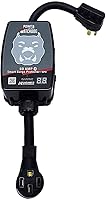
Best 30 Amp Surge Guard RV Surge Protectors: Top 9 Picks (November 2026)
The best 30 amp RV surge guard include the GEARGO RV Surge Protectors 30 Amp RV for most campers, the Kohree RV Surge Protector 30 Amp for wet campsites, and the GEARGO 𝟐𝟎𝟐𝟔 Smart RV Surge Protector 30 for live voltage tracking.
On this page (8 sections)
- Best 30 amp Surge Guard options for campers and travel trailers
- How these 30 amp guards compare side by side
- How we compared these 30 amp surge guards
- What should a 30 amp surge guard do at the pedestal?
- Do you need a voltage display and auto shutoff?
- How do 30 amp and 50 amp surge protectors differ?
- Frequently asked about 30 amp surge guard installs
- Which 30 amp surge guard should you buy?
The best rv surge guard 30 amp choice for most campers is the GEARGO 30 Amp RV (B0B38DJ5Z9), because 12,000 joules and six fault LEDs cover the wiring checks and spikes you meet at campground pedestals. Pick the smart GEARGO if you want a voltage display and automatic shutoff, or the Kohree if you want the bigger IP67 cover.
Every pick here plugs between the pedestal and your cord, so installation is the same: breaker off, plug in, read the lights, connect. The differences show up in how much surge energy each one absorbs, how many faults it names, and whether it cuts power on its own.
If your camper runs on a 50 amp cord, our 50 amp rv surge protector roundup covers those models. Campers who want to mix the two should read whether you can i use a 50 amp surge protector on my 30 amp rv before buying an adapter.
Our picks at a glance
-
1
-
2

-
3
 Best for live voltage tracking
GEARGO 𝟐𝟎𝟐𝟔 Smart RV Surge Protector 30
9.5/10 our score
See it on Amazon
- 4
 Check it
CARMTEK RV Surge Protector 30 Amp
Best for two-step pedestal testing - 5
 Check it
EPLCSE RV Surge Protector 30 Amp
Best for heat checks at the pedestal - 6
 Check it
Progressive Industries EMS-PT30X (30 Amp)
Best for full electrical management - 7
 Check it
MILLIONHOME RV Surge Protector 30 Amp
Best for simple plug and play - 8
 Check it
Southwire Surge Guard 30 Amp Portable
Best for the Surge Guard name - 9
 Check it
Progressive Industries SSP-30XL (30 Amp)
Best for basic fault warnings
Best 30 amp Surge Guard options for campers and travel trailers
The pair below are the two biggest names in portable protection, and the rest of the field has passed them on surge rating. Start with what each one handles at the pedestal, then work down the score list.
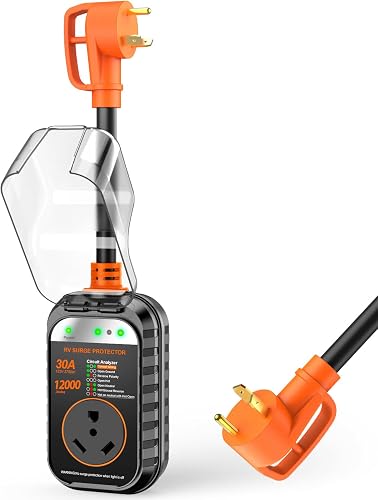
GEARGO RV Surge Protectors 30 Amp RV: Best for most campers
- 12,000 joules of surge protection
- Six-fault LED circuit analyzer
- IP68 waterproof cover
- GEARGO backs it with a 3-year warranty
A high joule rating and a full fault chart in one orange housing. It covers the wiring checks most 30 amp campers need before plugging in.
Pros
- 12,000 joules
- Six fault indications on the chart
- IP68 cover for rain and dust
Cons
- No live voltage display
- No automatic shutoff
This orange GEARGO suits a trailer that moves between campgrounds and sees a different pedestal every weekend. Its 12,000 joule absorption gives it more headroom against repeated spikes than any analyzer-only unit here.
The circuit analyzer checks correct wiring, open ground, open neutral, reverse polarity, hot and ground reversed, and no power. That chart covers the faults behind most dead-pedestal stories.
An IP68 waterproof cover and a right-angle male plug keep rain and cord strain from working the connection loose. The 3-year warranty is longer than most in this group.
Its trade-off is what it doesn't do: no voltage display and no automatic shutoff. If you want the protector to cut power on its own when voltage sags, the smart GEARGO below fits better.
Kohree RV Surge Protector 30 Amp: Best for wet campsites
- 12,000 joules absorbed within 1 ns
- Seven-fault LED analyzer
- IP67 cover sized for most RV plugs
- Pure copper and flame-retardant housing
The enlarged cover fits bulkier 30 amp plugs, and the analyzer flags seven fault patterns. It suits coastal or stormy campgrounds where rain hits the pedestal.
Pros
- Seven fault indications
- Cover fits most RV plugs
- Patent-protected plug design
Cons
- No auto shutoff
- No voltage readout
Kohree targets the camper who hooks up in rain or near the coast. The IP67 cover is enlarged so most RV power plugs fit under it, and the housing uses pure copper and flame-retardant PVC.
Its analyzer reads seven conditions, including open hot and hot on neutral with hot open. That's one more fault than the GEARGO chart, which matters when a pedestal has been wired by someone in a hurry.
Kohree rates absorption at 12,000 joules with a 1 ns response. The unit names seven appliance types it shields: air conditioners, refrigerators, electronics, water heaters, battery chargers, microwaves and kitchen gear.
Two U.S. design patents cover the housing and plug shape, which is unusual for this price tier and suggests the connector was engineered rather than copied.
The trade-off is the same as the top pick: no digital readout and no automatic cutoff. Choose Kohree over GEARGO if the bigger cover and extra fault light matter more.
Otherwise the two are close enough that price and availability decide.
GEARGO 𝟐𝟎𝟐𝟔 Smart RV Surge Protector 30: Best for live voltage tracking
- 16,000 joules
- Real-time LED voltage display
- Auto shutoff below 103 V or above 132 V
- IP68 waterproof cover
It shows voltage on a bright display and cuts power outside the safe band. That combination suits campers who want to see a problem before an appliance fails.
Pros
- Highest joule rating here
- Auto shutoff and reset
- Readable display in dim light
Cons
- Costs more than basic analyzers
- Display draws attention to numbers some campers won't watch
This GEARGO is the one to pick if you want to see voltage on the pedestal. A bright LED display shows the live reading, and the unit cuts power below 103 V or above 132 V, then resets.
Its 16,000 joule rating is the highest in this roundup. A nanosecond response time means a spike is intercepted before it reaches the camper's wiring.
IP68 protection keeps the electronics dry through rain, snow and dust. GEARGO says the housing resists corrosion, which suits damp coastal sites.
The 103 V minimum operating figure matches the low-voltage cutoff point, so the display and the shutoff tell the same story.
The trade-off is cost and complexity. A basic analyzer like the CARMTEK tells you the pedestal is safe for a fraction of the price.
The smart GEARGO earns its keep if you'll actually watch the display or camp where voltage sags on hot afternoons when everyone runs air conditioning.
CARMTEK RV Surge Protector 30 Amp: Best for two-step pedestal testing
- 2,100 joules
- Six-fault analyzer chart
- Weather resistant and thermally protected
- CARMTEK backs it with a lifetime warranty
Plug it in alone first, read the LEDs, then connect your cord. The lower joule rating is the trade-off for a simpler, lighter unit.
Pros
- Clear two-step test routine
- Lifetime warranty
- Right-angle male plug reduces cord bend
Cons
- 2,100 joules is low for this group
- No live display
CARMTEK suits the camper who wants a simple routine: plug the analyzer in alone, read the LEDs, then connect the RV. Its six-fault chart matches the GEARGO pattern.
The 2,100 joule rating is far below the leaders, so treat this as a pedestal tester that absorbs small surges. It is weather resistant and thermally protected, rated 30 A, 125 V, 3,750 W, with TT-30P and TT-30R plugs.
Grip handles and the right-angle male connector make it easy to pull off a stiff pedestal without bending the cord. The lifetime warranty is the longest here.
The CARMTEK also carries a UL listing and a wide temperature range, from -35 C to +110 C. That matters if you camp in desert heat or shoulder-season cold.
Choose it if you already trust your camper's onboard protection and want a light tester. Skip it if you camp in storm country where big spikes are common; the 12,000 and 16,000 joule units are the better shield.
EPLCSE RV Surge Protector 30 Amp: Best for heat checks at the pedestal
- 10,000 joules
- Six-fault analyzer
- FCC and RoHS certified
- Guidance on checking plug shell warmth
The TT-30R outlet refuses a 14-50 plug, so a mismatched hookup won't seat. Its heat-check advice helps you catch a loose or overloaded connection early.
Pros
- 10,000 joules
- Outlet blocks 14-50 plugs
- Flame-retardant housing
Cons
- No automatic shutoff
- No digital voltage readout
EPLCSE adds a heat-check habit to the analyzer routine. Its guidance says to feel the plug shell after running high-load gear: warm is fine, hot means cut power.
That's a practical way to catch a loose pedestal outlet before it melts a plug.
The 10,000 joule rating sits in the middle of this group. The TT-30R outlet won't accept a 14-50 plug, so a wrong-size cord simply won't seat.
The unit also spells out a startup order: shut off the pedestal breaker, plug the protector in, energize it for the self-test, then connect the RV cord.
FCC and RoHS certification, a V-1 flame-retardant body and a waterproof cover round out the safety side. The six-fault LEDs cover the usual pedestal wiring problems.
Its trade-off is no automatic shutoff and no voltage readout. Pick it if you like the heat-check method and want solid joules without the smart-unit price.
Skip it if you want the unit to act on its own.
Progressive Industries EMS-PT30X (30 Amp): Best for full electrical management
- 1,790 joules
- Over and under voltage protection
- Accidental 240 V and frequency monitoring
- Made in USA with Lexan housing
This is an EMS first and a surge protector second. It watches voltage, frequency and miswired pedestals, then shows error codes on a display screen.
Pros
- Monitors more fault types than an analyzer alone
- Clear display for error codes
- Rugged pull handle and locking bracket
Cons
- Low surge rating compared with the leaders
- Bulkier to store
The EMS-PT30X is the pick for campers who want the protector to manage the electrical supply, not just absorb spikes. It watches over and under voltage, open ground and neutral, reverse polarity, miswired pedestals, accidental 240 V and AC frequency, then shows error codes on a screen.
The surge rating is modest at 1,790 joules and 3,600 W capacity. The value is in the monitoring, not raw absorption.
Progressive Industries rates it for 44,000 amps of maximum spike current and temperatures from -40 C to +105 C.
A tough Lexan housing, an all-weather shield and a rugged pull handle suit outdoor use. The display is readable in low light, which helps when you arrive after dark.
The trade-off is bulk and low joules against the leaders. Choose it if a sagging pedestal or miswired site has bitten you before.
If you mainly want big surge protection, the GEARGO units do that job at a better rating.
MILLIONHOME RV Surge Protector 30 Amp: Best for simple plug and play
- 13,000 joules
- Flame-retardant housing
- Waterproof design
- 24-hour after-sales service line
A high joule count with nothing to configure. Keep the total load under 30 amps, since running an air conditioner and a microwave at once can overheat the unit.
Pros
- 13,000 joules
- No setup step
- Waterproof cover
Cons
- No circuit analyzer chart on the unit
- Load limits need attention
MILLIONHOME keeps it simple. Plug it in and it's working, with 13,000 joules of absorption and a waterproof flame-retardant housing.
There's nothing to set.
MILLIONHOME is clear about load: the maximum is 30 A, and running an air conditioner with a microwave and a charger can overheat it. That's the same limit every 30 amp camper faces, but this unit states it plainly.
The maker's own guidance also lists overload, loose connections, damaged cords and thin extension cords as causes of a hot unit.
The cover handles rain, wind and sandstorms, and a 24-hour service line backs it. It doesn't carry the printed fault chart the analyzers use, so you'll rely on the LED pattern.
Choose it if you want high joules and a plug-and-play habit. Skip it if reading a full fault chart before hooking up is part of your arrival routine.
For a camper that alternates 30 and 50 amp sites, see the 30 amp rv surge protector comparison.
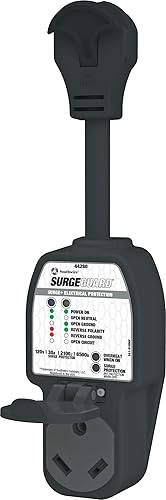
Southwire Surge Guard 30 Amp Portable: Best for the Surge Guard name
- 2,100 joules
- Enhanced diagnostics
- Thicker receptacle brass for lower heat
- Easy-T-Pull handle and anti-theft lock ring
The brand that made the name common, in a pop-up and travel trailer size. Its modest joule rating looks small next to the newer picks here.
Pros
- Recognizable Surge Guard brand
- Anti-theft lock ring on the cord
- Thicker brass reduces heat at the receptacle
Cons
- 2,100 joules is near the bottom of this group
- Fewer fault LEDs than the analyzers
This is the Southwire Surge Guard many campers mean when they say "surge guard." It's sized for pop-ups and travel trailers, with 2,100 joules and enhanced diagnostics.
The receptacle brass is thicker than a basic plug, which lowers heat at the connection. An Easy-T-Pull handle with an integrated receptacle makes disconnecting easier, and an anti-theft lock ring on the cord lets you secure it to the pedestal.
The enclosure is nylon, which keeps the unit light.
Southwire's 1-year warranty is short next to CARMTEK's lifetime or GEARGO's 3 years. The joule rating is near the bottom of this group.
Pick it if you want the familiar brand and the lock ring. Skip it if you want the strongest possible surge shield, because the newer analyzers here absorb several times the energy.
It still earns its spot for pop-up owners who want a light guard they can lock down.
Progressive Industries SSP-30XL (30 Amp): Best for basic fault warnings
- 825 joules
- Three-mode surge protection
- Over and under voltage warnings
- All-weather shield and thermal protection
A light guard for campers who mainly want a miswired pedestal warning. Its low joule rating means it won't absorb as big a spike as the leaders.
Pros
- Bright three-color LEDs
- Made in USA
Cons
- 825 joules is the lowest here
- No auto shutoff
The SSP-30XL is the lightest-duty pick here. Its 825 joules and three-mode protection cover small surges and pedestal warnings, not storm-grade spikes.
It still warns on over and under voltage, open ground and neutral, reverse polarity, surge failure and AC frequency. Three-color LEDs stay visible in poor light, and the Lexan housing and all-weather shield handle outdoor use.
Rated 30 A, 120 V, 3,600 W, it fits any 30 amp camper setup. A locking bracket and pull handle make setup easy.
Progressive Industries lists a 22,500 amp maximum spike rating and says the unit is made in the USA. Choose it if you want a small, light guard mainly for miswired pedestal warnings and you rarely see lightning.
Skip it if you camp in storm season; the 12,000 and 16,000 joule units are the better choice. As a second unit for a tent trailer that rarely leaves a fair-weather loop, it still does useful work.
How these 30 amp guards compare side by side
The table sorts what matters at the pedestal: joules, fault coverage, weather rating and whether the unit acts on its own. Use it to narrow the field, then read the write-up for the pick that fits your camping.
| Product | Best for | Amperage | Surge rating | Water rating | Our score |
|---|---|---|---|---|---|
| GEARGO RV Surge Protectors 30 Amp RV | most campers | 30 A | 12,000 J | IP68 | 9.7 |
| Kohree RV Surge Protector 30 Amp | wet campsites | 30 A | 12,000 J | IP67 | 9.6 |
| GEARGO 𝟐𝟎𝟐𝟔 Smart RV Surge Protector 30 | live voltage tracking | 30 A | 16,000 J | 9.5 | |
| CARMTEK RV Surge Protector 30 Amp | two-step pedestal testing | 30 A | 2,100 J | 9.5 | |
| EPLCSE RV Surge Protector 30 Amp | heat checks at the pedestal | 30 A | 10,000 J | 9.5 | |
| Progressive Industries EMS-PT30X (30 Amp) | full electrical management | 30 A | 1,790 J | 9.3 | |
| MILLIONHOME RV Surge Protector 30 Amp | simple plug and play | 30 A | 13,000 J | 9.1 | |
| Southwire Surge Guard 30 Amp Portable | the Surge Guard name | 30 A | 2,100 J | 8.3 | |
| Progressive Industries SSP-30XL (30 Amp) | basic fault warnings | 30 A | 825 J | 7.8 |
How we compared these 30 amp surge guards
We scored each unit on surge absorption, fault coverage, weather sealing and what the unit does after a fault appears.
The score weighs specs, features and buyer feedback against what you're shopping for. A 12,000 joule protector with six fault LEDs scores above a 2,100 joule unit with fewer checks, all else equal.
We also weighted whether the protector acts on its own. Units with automatic shutoff or a heat-check method moved up, because they catch problems after the initial plug-in.
Where a unit named the appliance types it shields, we counted that as evidence of how it handles loads.
Warranty length counted too, since a guard that lives outdoors takes abuse. A 3-year or lifetime warranty signals the maker expects the housing and electronics to hold up.
Where a unit listed a UL, FCC or RoHS mark, we gave credit for third-party testing.
What should a 30 amp surge guard do at the pedestal?
A 30 amp guard should test the pedestal wiring, absorb a surge before it reaches your camper and survive the weather. Do those three things and you're covered.
The differences between models are in how much energy they absorb and how clearly they report faults.
How many joules is enough?
For most campers, 10,000 joules or more is the comfortable range. The GEARGO units at 12,000 and 16,000 joules sit at the top, with the EPLCSE and MILLIONHOME close behind.
The 825 to 2,100 joule units still work for small spikes and pedestal testing. They just have less capacity before their protection is used up.
If you camp in lightning country, buy joules.
What does the circuit analyzer chart tell you?
A chart names each wiring fault with its own light pattern. Correct wiring, open ground, open neutral, reverse polarity and hot and ground reversed are the common ones.
Read the lights before you plug in your cord. If the pattern isn't "correct," move to another site or call the campground.
Is IP67 or IP68 worth it?
Yes, if you camp in rain. IP68 covers rain, snow and dust for longer periods than IP67, which handles rain and splashes.
For a protector that lives outdoors whenever you're hooked up, either rating is worth the small price step over a bare plug.
The cover also protects the connection from sand driven by desert wind, which grits up a plug and makes it hard to remove later.
Do you need a voltage display and auto shutoff?
Not for basic protection. A display and shutoff are worth it if your campground voltage sags or spikes when the park fills up.
The smart GEARGO cuts power below 103 V or above 132 V, then resets, so an air conditioner isn't left trying to start on low voltage. Without those features, you're the monitor.
That's fine if you watch the camp and plug in at sites with a good reputation.
A display also helps you spot a slow decline in voltage before it reaches the cutoff point. Watch it on a hot afternoon and you'll see the number fall as neighbors turn on air conditioners.
If your unit only has LEDs, the "safe" light tells you the wiring is correct but not how much margin you have. That's the gap the EMS and smart units close.
Does auto shutoff replace a breaker?
No. The shutoff protects your appliances from bad voltage; the pedestal breaker still trips when your total load passes 30 amps.
They solve different problems.
What's the difference between an analyzer and an EMS?
An analyzer only reads the pedestal before you connect. An EMS reads and reacts while you're plugged in.
The Progressive Industries EMS-PT30X does both, which is why it costs more and stores bulkier.
How do 30 amp and 50 amp surge protectors differ?
They differ in plug and capacity, not in job. A 30 amp unit uses TT-30 plugs; a 50 amp unit uses a 14-50.
The 30 amp side carries 3,600 W at 120 V, while 50 amp service offers more total power. You can't plug a 30 amp protector into a 50 amp outlet without an adapter, and a 50 amp protector won't fit a TT-30 pedestal.
Match the protector to your camper's cord.
If you own an adapter for the rare 50 amp site, keep an eye on heat at the joint. The EPLCSE guidance on checking plug shell warmth applies to adapters too.
A loose adapter is one of the most common causes of a hot connection.
Frequently asked about 30 amp surge guard installs
Getting the routine right matters more than the label on the box. These are the points campers hit on their first hookup.
Where does the guard go in the hookup order?
Shut off the pedestal breaker, plug in the protector, flip the breaker on and let it self-test. When the LEDs say safe, turn the breaker off, connect your RV cord to the protector, then turn the breaker back on.
Why does a pedestal pass the analyzer but trip my camper's breaker?
The analyzer reads wiring, not load. A breaker trip after hookup usually means your camper is pulling more than 30 amps.
Run one big appliance at a time and reset the breaker.
Can I leave the protector on the pedestal in winter?
Yes, if its cover is rated for the weather. An IP68 unit handles snow and prolonged rain.
Still disconnect it when you leave the site, both for theft and for the surge failure indicator check on arrival.
Which 30 amp surge guard should you buy?
Buy the GEARGO 30 Amp RV if you want the best mix of joules and fault checks for most campers. It's the strongest all-round rv surge guard 30 amp pick on this page for trailers that see different pedestals.
Choose the smart GEARGO if you want a voltage display and automatic shutoff. Take the Kohree if the bigger IP67 cover matters.
Pick the Progressive Industries EMS-PT30X if full electrical management is the priority over raw joules.
For a bigger rig, move up to the 50 amp rv surge protector roundup. If you're still weighing sizes, our guide on whether you can i use a 50 amp surge protector on my 30 amp rv settles the adapter question.
Our top 3 picks at a glance
-
1
-
2
-
3
Best for live voltage tracking
GEARGO 𝟐𝟎𝟐𝟔 Smart RV Surge Protector 30
9.5/10 our score
See it on Amazon
Frequently asked questions
What does the joule rating on an rv surge guard 30 amp actually measure?
Joules measure how much surge energy the unit can absorb before it gives out. A 16,000-joule protector handles repeated big spikes better than an 825-joule unit, but both stop a single large surge from reaching your camper.
Do I need a circuit analyzer, an EMS or both?
An analyzer checks the pedestal before you plug in and flags miswiring. An EMS like the Progressive Industries EMS-PT30X also cuts power for over or under voltage and frequency problems.
If you camp often on unknown pedestals, an EMS earns its space.
Why does my surge guard show an open ground warning?
An open ground reading usually points to a pedestal or generator without a proper ground path, not a broken protector. Report it to the campground and move to another site before connecting your cord.
Can a 30 amp protector handle a rainy weekend?
Yes, if its cover is rated for the weather. IP68 units survive rain and dust, while IP67 covers handle rain and splashes.
Keep the cover closed on the pedestal connection and check it after the first storm.
How often should I replace a 30 amp surge guard?
Replace it after it absorbs a large surge, or when the surge failure light comes on. Like a fuse, its protection is spent once it takes a big hit, and a spent unit still passes power without warning you.
Will a 30 amp protector limit what I can run in my camper?
No. The 30 amp limit is your pedestal's, not the protector's.
Running the air conditioner, microwave and water heater together can still trip the breaker, so watch the load as you would without one.