RV Surge Protector Ratings Explained
An RV surge protector rating is really three separate numbers: amps and volts tell you whether the unit fits your rig's service, and joules tell you how much surge energy it can absorb. A 30 amp unit on a 50 amp rig won't fit, and a high joule count alone doesn't make a protector safe.
On this page (9 sections)
- What do the amps and volts ratings on an RV surge protector mean?
- How do joules and surge capacity ratings work?
- Which protection features should you check besides joules?
- How should you read a typical RV surge protector spec line?
- What do real units show about reading these ratings?
- How do portable and hardwired ratings compare?
- What do Camco and other brands add to the rating picture?
- What ratings matter most for a first time buyer?
- How should you interpret RV surge protector ratings when shopping?
An RV surge protector rating tells you what a unit can handle and what it can detect, not just how big the number on the box is. Match amps and volts to your rig first, then judge joules and protection features.
That order matters because the biggest joule number in the catalog is useless if the plug doesn't fit your camper's inlet. Read the amps and volts line before you read anything else.
This guide walks through each rating in plain terms and shows how real products line up. If you want the basics first, our explainer on what does an RV surge protector do covers the job these devices perform.
What do the amps and volts ratings on an RV surge protector mean?
Amps and volts describe the electrical service the protector is built for, so they decide fit before protection. A 30 amp unit is made for a 30 amp rig, and a 50 amp unit for a 50 amp rig.
The amp rating appears in the product name for a reason. A 30 amp RV pulls up to 30 amps on each hot leg through a standard 30 amp shore cord.
A 50 amp RV splits its load across two hot legs and needs a protector with the matching 50 amp plug and socket.
Voltage follows the same logic. A 30 amp RV runs on 120 volts, while a 50 amp service carries 120 volts on each leg, for 240 volts across both.
A protector rated for 120 volts is not the right part for a 50 amp inlet.
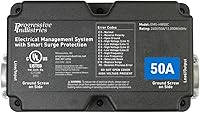
A 30 amp unit like the Progressive Industries EMS-PT30X is rated at 30 amps and 120 volts with a 3,600 watt capacity. That 3,600 watts is simply 30 amps times 120 volts, so the number confirms the service it belongs on.
An adapter changes the plug shape so you can connect to a different pedestal outlet. It does not turn a 30 amp protector into a 50 amp protector.
The protector's own rating still has to suit your rig.
Hardwired units carry the same amps and volts logic. Our roundup of the hardwired rv surge protector options groups them by service size.
Why the pedestal outlet isn't the deciding number
Campground pedestals often offer several outlet shapes, and you may plug a 30 amp rig into a 50 amp pedestal through an adapter. That does not change what your camper's wiring needs.
Size the protector to the RV's inlet. The pedestal is just the supply point; your rig's breaker panel and cord define the load.
Buy the protector rated for your rig's service, and use adapters only for the pedestal end. If you own a 50 amp coach and a 30 amp trailer, each needs its own matching protector.
How do joules and surge capacity ratings work?
Joules measure how much surge energy a protector can absorb over its working life. A higher joule number means more capacity to soak up spikes, but it is not a measure of wiring protection.
Think of joules as the size of the cushion. Every surge pushes into that cushion, and a protector with more joules can take more hits before it degrades.
Once the cushion is used up, the surge protection layer stops doing its job.
The Progressive Industries EMS-PT30X is rated to absorb surges up to 1,790 joules. The Power Watchdog PWD50EPO carries a 6,100 joule rating.
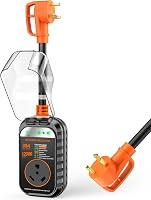
The Southwire Surge Guard 30 Amp Portable is rated at 2,100 joules.
Those three numbers span a wide range, and the difference is real. But a 6,100 joule unit and a 1,790 joule unit both protect your appliances on the first big spike.
The larger rating simply gives more room before replacement.
Surge capacity also interacts with the surge module design. The Power Watchdog uses a replaceable surge module, so a major event does not necessarily mean buying a whole new unit.
That changes how you think about joules over time.
Do not buy on joules alone. A unit with a huge number but no fault detection leaves your rig exposed to wiring problems that a surge alone would never cause.
Weigh the surge rating next to the protection features in the next section.
Surge energy vs maximum spike current
Some units pair a maximum current spike rating with the joule figure. The EMS-PT30X pairs its 1,790 joules with a 44,000 amp maximum current spike rating.
These two numbers describe different things. Joules cover total energy absorbed, while the spike current figure covers the size of an individual current surge the unit can pass safely.
When you compare RV surge protector ratings, read both figures as one story. A unit needs enough of each to survive a strike, and the joule rating is the one you'll see most often.
Which protection features should you check besides joules?
Protection features decide whether the unit will refuse bad power before it reaches your camper. Look for over and under voltage protection, open ground and neutral detection, reverse polarity and miswired pedestal checks.
These are the faults that actually damage RV appliances, and many happen at campgrounds where wiring has aged or been repaired poorly. A surge-only device won't stop a reversed hot and neutral connection.
The Progressive Industries EMS-PT30X guards against over and under voltage, open ground and neutral, reverse polarity, a miswired pedestal, accidental 240 volts, surge failure and AC frequency issues. That list reads like a checklist of what goes wrong on the road.
The Power Watchdog PWD50EPO uses advanced circuit analysis to shut off power in an emergency. Its description sets the shutoff window at below 104 volts or above 132 volts, then a 90 second delay before power returns after the fault clears.
The Southwire Surge Guard 30 Amp Portable focuses on identifying faulty park power and providing surge protection. Its diagnostics target the pedestal, so you know whether the problem is upstream.
A protector with fault detection acts as a gatekeeper. A unit with surge absorption only acts as a cushion.
For most RV owners, the gatekeeper is the more useful device, and the protection list is the rating worth reading closely.
What accidental 240 volts means for a 30 amp rig
A miswired 50 amp pedestal can send 240 volts into a 30 amp rig through an adapter. That mistake can destroy converters and appliances in seconds.
A protector that checks for accidental 240 volts catches this before your rig sees it. The EMS-PT30X lists that protection, which is why the fault feature list matters as much as the joule count.
How should you read a typical RV surge protector spec line?
Read a spec line in a fixed order: amps and volts first, then joules, then protection features. That sequence filters out units that don't fit or don't guard the faults you'll meet.
Start with the amp and volt rating. Cross out anything that doesn't match your rig's inlet.
This single step removes most wrong choices.
Next, note the joule rating and how the surge module is handled. A replaceable module changes the long term cost of owning a high energy unit.
Then scan the fault list. Over and under voltage, open ground and neutral, reverse polarity and frequency issues cover the common campground hazards.
If a spec sheet omits these, treat the unit as surge only.
Finally, look at the housing and display. An all weather shield and a clear display matter when you're plugging in at dusk in the rain.
These details are not electrical ratings, but they decide whether you'll actually use the device correctly.
Our comparison of rv ems surge protector picks shows how these spec lines differ across brands. A quick read of two units side by side makes the pattern obvious.
A quick reading checklist
- Does the amp and volt rating match my RV's inlet?
- What is the joule rating, and is the surge module replaceable?
- Does the unit detect over and under voltage, open ground, open neutral and reverse polarity?
- Does it flag accidental 240 volts and frequency problems?
- Is the housing weather rated and the display readable?
Use this order every time, and the marketing numbers stop distracting you from the ratings that keep your camper safe.
What do real units show about reading these ratings?
Comparing three popular units shows how the same rating labels play out in different builds. The amp rating and fault list separate them more than the joule count does.
The EMS-PT30X pairs its moderate joule rating with the widest fault detection list of the three. Its all weather shield, thermal protection and integrated display support outdoor use.
The Power Watchdog leads on surge energy and adds app monitoring of voltage, amperage and wattage. Its 90 second power-on delay after a fault gives conditions time to settle.
The Southwire Surge Guard sits in the middle on joules and emphasizes pedestal diagnostics. Its Easy-T-Pull handle and anti-theft lock ring address the practical side of campground hookups.
Read together, these units show why ratings work as a set. Pick the amps first, then decide how much fault detection and surge capacity you want to carry.
How do portable and hardwired ratings compare?
Portable and hardwired protectors use the same amps, volts and joule ratings, but they differ in where the protection sits. A portable unit plugs in at the pedestal, while a hardwired unit installs inside the RV's electrical bay.
A portable unit is easy to move between rigs and simple to replace. You can also see its display from outside, which helps when you check a new pedestal before connecting.
A hardwired unit stays with the RV and protects every connection without setup. It also avoids the theft risk that comes with a device left at the pedestal, and there is no plug to forget.
The ratings don't change with the mounting style. A 30 amp hardwired unit and a 30 amp portable unit carry the same service rating.
What changes is convenience, visibility and installation effort.
If you want the protection built in, browse the hardwired rv surge protector picks. If you want to move one device between a trailer and a tow vehicle, portable makes more sense.
Which mounting style suits your routine?
Pick portable if you swap RVs, want to inspect the pedestal before plugging in, or prefer to keep the electrical work outside. Pick hardwired if you want protection that is always present and can't be left behind.
Let your routine decide, not the rating label. Both styles carry the same electrical numbers, so the choice comes down to how you camp.
What do Camco and other brands add to the rating picture?
Camco and similar brands sell protectors across the same amp and joule ranges, and their ratings follow the same rules. Read a Camco spec line with the same amps-first order you use for any brand.
Camco units often appeal to buyers who want a simple, recognizable portable device. Their ratings still list amps, volts and joules, and the fault features vary by model.
The lesson is brand neutral. A protector's value comes from matching amps to your rig and covering the faults you'll meet, not from the badge on the housing.
Our camco rv surge protector roundup compares the models in that family. Use it to see how their ratings line up against the Progressive Industries and Power Watchdog units here.
Should brand name change how you read a rating?
No. Ratings are electrical facts, and every maker lists them in the same units.
A 30 amp, 1,790 joule unit from one brand protects the same load as a 30 amp, 1,790 joule unit from another.
Compare the numbers, then the features, and use brand only as a tiebreaker for housing quality, display design or support.
What ratings matter most for a first time buyer?
For a first protector, amps and volts come first, fault detection second, and joules third. Get the fit right and the fault list solid before you chase a bigger surge number.
A first time buyer usually wants protection against the most common campground problems: low voltage on hot afternoons, miswired pedestals and storms that spike the supply. Fault detection covers the first two, and joules cover the third.
Start with the amp rating for your rig. A 30 amp trailer owner should look at 30 amp units first.
A 50 amp coach owner needs a 50 amp unit, even if the joule count looks lower than a 30 amp model's.
Then check the fault list. Over and under voltage protection is the feature that saves air conditioners and converters from brownouts.
Open ground and neutral detection catches wiring faults that a surge protector alone would ignore.
Set a joule floor rather than a target. Anything in the low thousands handles typical spikes.
Spending up for more joules makes sense when you camp in storm-prone areas or want a replaceable module.
Match amps, insist on fault detection, then choose joules to fit your budget. That order keeps a first purchase sensible.
How should you interpret RV surge protector ratings when shopping?
Treat the ratings as a filter, not a scoreboard. The right protector matches your rig's amps and volts, detects the faults you'll meet, and carries enough joules for your camping style.
A big joule number on the wrong service size is a wasted buy. A perfect service match without fault detection leaves your electronics exposed to wiring problems.
The strongest choice satisfies both.
When you read rv surge protector ratings from now on, start with amps and volts, scan the fault list, then weigh joules and module design. That sequence turns a crowded product page into a short list of units that actually fit your camper.
If your rig's inlet and your camping habits are settled, the next step is comparing the units that pass the filter. Our rv ems surge protector picks and the Camco rv surge protector roundup show how the top models line up on those same ratings.
Pick by amps first, then features, then joules. Your rig's service size is the one rating that cannot be adjusted after the fact.
Frequently asked questions
Is a higher joule rating always better on an RV surge protector?
A higher joule count means the unit can absorb more surge energy before it wears out, but it says nothing about wiring protection. Look for fault detection and a shutdown response alongside the joules.
What does clamping voltage mean on an RV surge protector?
Clamping voltage is the point where the protector starts diverting excess voltage, and a lower number means it reacts sooner. It is not the same as the cutoff threshold a unit uses to disconnect your RV's power.
Do I need a 30 amp or 50 amp surge protector for my camper?
Match the protector to your RV's shore power inlet, not the pedestal. A 50 amp rig needs a 50 amp protector, while a 30 amp trailer needs a 30 amp unit; adapters change the plug shape but not the rig's service rating.
What is the difference between a surge protector and an EMS?
A surge protector absorbs voltage spikes, while an EMS also monitors and disconnects power when voltage, wiring or frequency goes out of range. Many units sold as RV surge protectors include EMS features.
How often should an RV surge protector be replaced?
Replace a protector when its surge module or indicator shows it has absorbed a major event. Units with a replaceable module let you swap that part instead of buying a whole new device.