How to Compare RV Surge Protectors
Compare RV surge protectors on five lines first: amperage (30 or 50 amp), joule rating, the faults it detects, plug-in or hardwired install, and the warranty. Amperage must match your rig's inlet; the rest decides how much protection you get and how much you pay for it.
On this page (9 sections)
- How do I read an RV surge protector comparison chart?
- Why does amperage come first in any comparison?
- What does the joule rating actually tell you?
- Which faults and protection features belong on the chart?
- Portable or hardwired: which install style fits your rig?
- How do the three 30 amp protectors compare line by line?
- Where do brand, warranty and build quality fit?
- How should I build my own comparison chart?
- Which protector should you pick from the chart?
The quickest way to compare RV surge protectors is a chart with five columns: amperage, joules, faults detected, install style and warranty. The first line that matters is amperage, because a 30 amp unit cannot serve a 50 amp inlet.
Everything after that is a trade-off between surge capacity, electrical monitoring and how the unit mounts.
That is the core of any rv surge protector comparison chart worth reading. A 30 amp portable unit and a 50 amp hardwired unit sit in different jobs, so comparing them head to head tells you nothing useful.
Put each candidate into the same five columns and the choice usually narrows to two or three models.
This guide walks through each line of the chart in the order that matters. It uses three 30 amp protectors as worked examples so you can see how the lines separate real products.
If you are still deciding whether you need one at all, read what does an RV surge protector do first.
How do I read an RV surge protector comparison chart?
Read the chart from left to right, amperage first, then joule rating, then fault detection. A unit that matches your amperage but only counts joules is a surge strip; one that also monitors voltage is an EMS.
The chart should show you which one you are looking at.
Most comparison charts stop at joules. That single number gets the most attention and answers the least.
Joules tell you how much energy a unit can absorb once, before it gives its life for your rig. They say nothing about a low-voltage pedestal that slowly damages your air conditioner, or a miswired connection that puts power where it shouldn't be.
A useful chart also shows the install style. Portable units plug in at the pedestal.
Hardwired units mount inside the rig's electrical bay. The two do different jobs and carry different risks.
Our best hardwired RV surge protector roundup covers the mount-inside option if that fits your rig.
Finally, look for what the unit checks before power reaches your RV. Over and under voltage, open ground, open neutral, reverse polarity, a miswired pedestal and accidental 240 volts are the standard list on a full electrical management system.
A plain surge protector checks almost none of them.
Build your own chart with these five columns and fill them from the product data, not from marketing lines. That habit alone will keep you from buying a 12,000-joule unit that protects nothing but the surge itself.
Rule: any protector you shortlist must name its faults, not just its joules.
Why does amperage come first in any comparison?
Amperage decides which protectors can even connect to your rig. Check the inlet on your RV, not the pedestal breaker.
A 30 amp rig needs a 30 amp protector, and a 50 amp rig needs a 50 amp unit.
RV shore power comes in two standard sizes. A 30 amp inlet is a single hot leg at 120 volts.
A 50 amp inlet is two hot legs at 120 volts each, for 240 volts across both. The plugs are different shapes on purpose so you cannot cross them by accident.
If you buy the wrong size, the protector either will not plug in or will not carry the full load. A 50 amp protector on a 30 amp rig through an adapter cord still sees only the current the rig draws, so the extra capacity does nothing for you.
A 30 amp protector on a 50 amp rig cannot feed both legs and will trip or fail under real load.
Check the label on your rig's inlet cover. It states the amperage in plain text.
If your rig came with a 50 amp cord and a 30 amp adapter, buy to the inlet, not the cord you usually use.
The three examples in this guide are all 30 amp units, so the chart's first column is already set for them. For a 50 amp rig, run the same five columns against 50 amp models.
Our best RV EMS surge protector roundup includes both sizes.
Rule: buy to the inlet amperage and ignore every other rating until that column matches.
What does the joule rating actually tell you?
The joule rating tells you how much surge energy the unit can absorb before it sacrifices itself. Higher is better within a size class, but it is not the whole story and it does not measure fault protection.
Joules measure energy, not time. A 1,790-joule unit and a 12,000-joule unit both do the same basic job: they divert a spike away from your appliances and absorb what is left.
The difference is how big a spike each one survives before it stops protecting.
Surges come from lightning strikes nearby, utility switching and the pedestal itself. A unit rated for more joules gives you more margin on a bad day.
But once a protector takes a big hit, it usually needs replacing, and many units show a surge failure indicator so you know it is spent.
Here is how the three examples land on this line. The GEARGO unit is rated at 12,000 joules.
The Progressive Industries EMS-PT30X is rated at 1,790 joules. The Southwire Surge Guard is rated at 2,100 joules.
Those numbers are not the whole picture because the Progressive and Southwire units also monitor voltage, which the joule count does not reflect.
A 12,000-joule unit with no voltage monitoring is not automatically better than a 1,790-joule EMS. Joules protect against spikes.
Voltage monitoring protects against slow damage. Your rig needs both.
Rule: read joules as a size, not a score. Then check the fault list before ranking.
Which faults and protection features belong on the chart?
Fault detection is the line that separates a surge strip from a real electrical management system. A full EMS checks over and under voltage, open ground, open neutral, reverse polarity, miswired pedestal, accidental 240 volts, surge failure and AC frequency.
The Progressive Industries EMS-PT30X covers that full list. Its data names over and under voltage protection, open ground and neutral detection, reverse polarity protection, accidental 240 volt protection, a surge failure indicator and AC frequency monitoring.
That is what makes it an EMS rather than a surge protector.
The Southwire Surge Guard 30 Amp identifies faulty park power and provides surge protection. Its Enhanced Diagnostics label points to the same job of checking the pedestal before you trust it.
It offers 2,100 joules and includes an anti-theft lock ring on the cord.
The GEARGO unit takes a different approach. It calls itself a circuit analyzer and names its diagnostic chart faults in plain text: correct wiring, open ground, open neutral, reverse polarity, hot/ground reversed and no power.
It also claims 12,000 joules and an IP68 waterproof design with a flame-retardant housing.
Read the fault column as a checklist. Write down each fault a unit catches and compare lists side by side.
The unit that catches the most faults on your list wins this column, whatever its joule count.
Rule: rank fault coverage above joule count, because slow voltage damage costs more than most spikes.
Portable or hardwired: which install style fits your rig?
Pick portable if you move the protector between rigs or want to carry it with you. Pick hardwired if you keep one rig and want the unit mounted inside and out of sight.
The chart's install column should say which one you are buying.
A portable protector plugs into the pedestal and your RV's cord plugs into it. Setup takes seconds.
The trade-off is theft risk, because the unit sits outdoors at the pedestal where anyone can reach it. Locking brackets and anti-theft rings help but do not remove the risk.
All three examples here are portable 30 amp units. The Progressive Industries EMS-PT30X includes a locking bracket.
The Southwire Surge Guard includes an anti-theft lock ring on its cord. The GEARGO unit uses ergonomic power grip handles and a right-angle male connector for easier plugging and less bending.
A hardwired protector mounts inside the rig's electrical bay and stays there. You lose the setup time and the theft risk.
You gain a unit that works without you touching it, and you lose the ability to move it to another rig. If you keep one RV long term, hardwired is the cleaner choice.
One more install detail belongs on the chart: the connector shape. A right-angle male plug keeps the cord close to the pedestal and out of the walkway.
Straight plugs stick out and take more abuse.
Rule: buy portable for flexibility, hardwired for security, and match the connector to your pedestal.
How do the three 30 amp protectors compare line by line?
On the five-line chart, the GEARGO unit leads on joules and waterproofing, the Progressive Industries unit leads on fault coverage and housing durability, and the Southwire unit sits in the middle with solid diagnostics and an anti-theft ring. Each one wins a different column, so the chart decides by which column matters most to you.
Here is how the three fill the chart.
| Product | Best for | Our score |
|---|---|---|
| GEARGO RV Surge Protectors 30 Amp RV | ||
| Progressive Industries EMS-PT30X (30 Amp) | ||
| Southwire Surge Guard 30 Amp Portable |
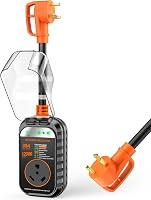
The GEARGO RV Surge Protectors 30 Amp RV is a circuit analyzer first. It checks wiring faults before you connect and reports them on a diagnostic chart.
Its 12,000-joule rating is the highest of the three, and the IP68 waterproof rating with a V-1 flame-retardant housing is a real advantage at a wet pedestal. The right-angle male connector and power grip handles make it easier to plug in and pull out safely.
The Progressive Industries EMS-PT30X is the fault monitor. Its electrical management system covers over and under voltage, open ground and neutral, reverse polarity, miswired pedestal, accidental 240 volts, surge failure and AC frequency.
Its 1,790 joules are the lowest of the three, but the fault list is the longest. It includes a locking bracket and a tough Lexan housing with an all weather shield assembly.
The Southwire Surge Guard 30 Amp sits between them. It offers 2,100 joules, enhanced diagnostics for faulty park power and an anti-theft lock ring on the cord.
It is rated for 30 amp and 120 volts. Its increased receptacle brass thickness is aimed at reducing heat at the connection, which matters when the pedestal runs warm.
Rule: pick GEARGO for waterproofing and joules, Progressive for fault coverage, Southwire for a middle ground with theft protection.
Where do brand, warranty and build quality fit?
Brand matters less than the spec lines, but warranty and build quality belong on the chart. Check the warranty length and the housing material, because both decide how long the unit lasts in rain and sun.
The GEARGO unit carries a 3-year warranty. That is the longest of the three examples.
Its V-1 flame-retardant housing and IP68 waterproof cover are aimed at rain, wind and sandstorms.
The Progressive Industries unit is made in the USA. Its housing is described as tough Lexan with an all weather shield assembly and thermal protection.
It includes a locking bracket and an integrated display for low light. Its temperature range runs from -40°C to +105°C, which covers most camping conditions.
The Southwire unit uses a nylon enclosure and a 1.5 pound body. Its Easy-T-Pull handle and integrated receptacle make it easy to handle at the pedestal.
Its increased receptacle brass thickness is a build detail aimed at reducing heat.
Build quality is hard to judge from a chart, so use the housing material and the warranty as proxies. A flame-retardant housing and a long warranty are both signs the maker expects the unit to sit outdoors.
If a unit gives you neither, rank it lower.
Rule: a long warranty and a weatherproof housing beat a slightly higher joule count.
How should I build my own comparison chart?
Start with a blank five-column table and fill it one row per product. Leave a row out if the amperage does not match your rig, because a wrong-size unit fails the first column and never earns a place on the chart.
Follow these steps.
- Write your inlet amperage at the top. Only units that match go in the table.
- Fill the joule column from the product data. Treat it as a size, not a score.
- List every fault each unit checks. Count them and rank by count.
- Mark the install style: portable or hardwired.
- Note the warranty and the housing material.
- Add a connector column if you care about right-angle plugs or lockable brackets.
Then weight the columns by your situation. A rig parked long term in a wet climate should weight waterproofing and housing high.
A rig that moves between campgrounds should weight portable setup and theft protection high. A rig with expensive electronics should weight fault coverage highest.
Do not let one column decide the whole chart. A 12,000-joule unit with no voltage monitoring protects against one problem and leaves the door open to another.
The best chart balances joules against faults.
Once your chart is built, shortlist two or three units and compare only those. More rows usually means more confusion, not a better choice.
Rule: fill the chart from product data, weight the columns to your climate and rig, then shortlist three.
Which protector should you pick from the chart?
For most 30 amp rigs, the chart's best overall pick is the GEARGO RV Surge Protectors 30 Amp RV. It wins on joules and waterproofing and carries a 3-year warranty, so it covers the most ground for the widest range of campers.
Its circuit analyzer checks wiring faults before you connect, and its 12,000-joule rating is the highest of the three.
The chart does not end there. Pick the Progressive Industries EMS-PT30X if fault coverage is your top line.
Its electrical management system checks the longest fault list of the three, including over and under voltage and AC frequency. That matters most if your rig has sensitive electronics or you camp where pedestal power is unreliable.
Pick the Southwire Surge Guard 30 Amp if you want a middle ground. It offers 2,100 joules, enhanced diagnostics and an anti-theft lock ring on the cord.
Its brass-thickened receptacle is aimed at reducing heat at the connection.
That is the whole point of an rv surge protector comparison chart: it turns three similar-looking products into three different jobs. Match the column that matters most to your rig, then buy the unit that wins it.
If you are weighing portable against hardwired for a rig you keep long term, the hardwired rv surge protector roundup is the next stop.
Rule: pick GEARGO for the widest coverage, Progressive for the most faults caught, Southwire for theft protection at a mid-range spec.
Frequently asked questions
Is a higher joule rating always better on an RV surge protector?
No. A higher joule rating means the unit absorbs more surge energy before it sacrifices itself, but joule count says nothing about voltage faults.
A 1,790-joule unit with over and under voltage protection can serve you better than a 12,000-joule unit that only catches surges.
Can I use a 50 amp surge protector on a 30 amp RV?
A 50 amp protector fits a 50 amp inlet only. If your rig has a 30 amp inlet, buy a 30 amp unit, or use a properly rated adapter cord and expect the protector to treat the connection as 30 amp.
Mixing sizes without an adapter is a wiring mismatch.
Do portable RV surge protectors need to be locked up?
Yes, lockable models help. A portable unit sits at the pedestal where it can walk away, so look for a locking bracket or anti-theft ring in the box.
A hardwired unit mounts inside the rig and removes that risk.
What should the comparison chart show for fault detection?
List each fault the unit checks: over and under voltage, open ground, open neutral, reverse polarity, miswired pedestal, accidental 240 volts and AC frequency. A plain surge-only unit catches almost none of these.
Fault detection is the line that separates a surge strip from an EMS.
Is a hardwired RV surge protector better than a portable one?
Hardwired is better for security and set-and-forget use because it mounts inside the rig. Portable is better for switching between rigs or carrying with you.
Pick hardwired for one rig you keep, portable if you rent, borrow or trade RVs.
How many amps do I need for my RV surge protector?
Match the amperage to your rig's shore power inlet. A 30 amp inlet takes a 30 amp protector; a 50 amp inlet takes a 50 amp protector.
Check the inlet label on your rig, not the breaker at the pedestal.