9 Best LiFePO4 Batteries for RV House Power (October 2026)
The best LiFePO4 batteries for RV house power include the LiTime 12V 100Ah Self-Heating LiFePO4 for cold-weather charging, the LiTime 12V 100Ah LiFePO4 Group 24 for compact Group 24 compartments, and the ECO-WORTHY 12V 100Ah Bluetooth LiFePO4 for app-based troubleshooting.
On this page (8 sections)
- How we chose these LiFePO4 batteries for RVs
- Compare the best RV LiFePO4 batteries
- The best LiFePO4 batteries for RV house power
- What should you check before choosing an RV LiFePO4 battery?
- How do cold-weather limits affect RV battery choice?
- Does a Group 24 battery fit every RV compartment?
- Can a 100Ah LiFePO4 battery run an RV air conditioner?
- Which LiFePO4 battery is the right RV pick?
The best LiFePO4 battery for RV house power for most buyers is the LiTime 12V 100Ah Self-Heating LiFePO4, with two heating modes, Bluetooth monitoring and a Group 24 fit. For a compact battery without self-heating, consider the LiTime Group 24 model; for a charge readout on the battery itself, choose the ECO-WORTHY with SOC display.
A 100Ah battery is a starting point, not a full system plan. Your daily energy use, charging sources, compartment dimensions and winter temperatures all affect which battery makes sense.
Use our RV lithium battery size guide to estimate capacity before choosing a model. If your battery sits in a tight compartment, compare Group 24 and Group 31 lithium batteries by their actual dimensions.
Our picks at a glance
-
1
 Best for cold-weather charging
LiTime 12V 100Ah Self-Heating LiFePO4
9.1/10 our score
See it on Amazon -
2
 Best for compact Group 24 compartments
LiTime 12V 100Ah LiFePO4 Group 24
8.9/10 our score
See it on Amazon -
3
 Best for app-based troubleshooting
ECO-WORTHY 12V 100Ah Bluetooth LiFePO4
8.7/10 our score
See it on Amazon
- 4
 Check it
Super Empower 12V 100Ah LiFePO4 Group 24
Best for lithium-charger flexibility - 5
 Check it
ECO-WORTHY 12V 100Ah LiFePO4 With SOC Display
Best for checking charge at the battery - 6
 Check it
Power Queen 12V 100Ah LiFePO4 Group 24 Bluetooth
Best for growing a battery bank - 7
 Check it
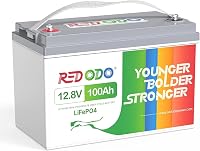
Redodo 12V 100Ah LiFePO4 Group 24 Bluetooth
Best for remote status checks - 8
 Check it
Dyness 12V 100Ah Bluetooth LiFePO4
Best for a lighter compact battery - 9
 Check it
HeyFuture 12V 100Ah Bluetooth LiFePO4
Best for a standard Group 24 replacement
How we chose these LiFePO4 batteries for RVs
We compared battery capacity, physical fit, cold-weather protections, monitoring features and charging guidance for RV house-power use. Our score weighs specs, features and buyer feedback against what you're shopping for.
All 9 picks here are 12V 100Ah batteries. That makes the differences in cold-weather charging, app access, displays and stated dimensions easier to compare.
A battery's Group size is only a starting point for fit. Check the battery compartment's usable length, width and height, along with terminal clearance and hold-down space.
Compare the best RV LiFePO4 batteries
The top choice has self-heating modes, while the other picks focus on compact fit, monitoring or battery-bank expansion. Compare capacity and size first, then look at charging protections and the features you'll use.
| Product | Best for | Capacity | Dimensions | Monitoring | Our score |
|---|---|---|---|---|---|
| LiTime 12V 100Ah Self-Heating LiFePO4 | cold-weather charging | 100Ah | 20.98 x 8.19 x 8.5 in | Bluetooth 5.0 app | 9.1 |
| LiTime 12V 100Ah LiFePO4 Group 24 | compact Group 24 compartments | 100Ah | 10.24 x 6.61 x 8.89 in | Bluetooth 5.0 app | 8.9 |
| ECO-WORTHY 12V 100Ah Bluetooth LiFePO4 | app-based troubleshooting | 100Ah | 10.23 x 6.6 x 8.23 in | Bluetooth 5.1 app | 8.7 |
| Super Empower 12V 100Ah LiFePO4 Group 24 | lithium-charger flexibility | 100Ah | 6.49 x 10.24 x 8.98 in | 8.5 | |
| ECO-WORTHY 12V 100Ah LiFePO4 With SOC Display | checking charge at the battery | 100Ah | 11.8 x 6.9 x 8.7 in | LED display and Bluetooth app | 8.4 |
| Power Queen 12V 100Ah LiFePO4 Group 24 Bluetooth | growing a battery bank | 100Ah | 6.61 x 10.24 x 8.27 in | Bluetooth app | 8.3 |
| Redodo 12V 100Ah LiFePO4 Group 24 Bluetooth | remote status checks | 100Ah | 6.61 x 10.24 x 8.27 in | Bluetooth app within 10 m | 8.0 |
| Dyness 12V 100Ah Bluetooth LiFePO4 | a lighter compact battery | 100Ah | 10.19 x 6.61 x 8.22 in | 7.9 | |
| HeyFuture 12V 100Ah Bluetooth LiFePO4 | a standard Group 24 replacement | 100Ah | 6.61 x 10.24 x 8.3 in | Bluetooth | 7.7 |
The best LiFePO4 batteries for RV house power
The right battery depends on where it sits, how you charge it and how much information you want at a glance. Each pick below is a 12V 100Ah model with features suited to a different RV setup.
LiTime 12V 100Ah Self-Heating LiFePO4: Best for cold-weather charging
- Two self-heating modes
- Bluetooth 5.0 monitoring
- Group 24 fit
- Low-temperature protections
Two heating modes make this the clearest fit for an RV that may need charging in cold conditions. Bluetooth app monitoring and a Group 24 fit add practical details for house-power use.
Pros
- Two heating modes
- Bluetooth status monitoring
- Group 24 fit
Cons
- Check compartment dimensions before buying
- Use a lithium-compatible charger to activate Bluetooth
The LiTime 12V 100Ah Self-Heating LiFePO4 is the strongest choice here for RV owners who may need to charge in cold weather. It has Regular and Energy-Efficient heating modes, with charging-related heating described below 41°F and a stop point at 50°F.
Bluetooth 5.0 connects to the LiTime app for status and power-level checks. The battery is described as fitting a Group 24 box, but its stated dimensions are 20.98 x 8.19 x 8.5 in, so measure your compartment rather than relying on the group label alone.
LiTime says the battery supports 4,000+ deep cycles at 100% depth of discharge and provides a 5-year warranty. The battery's 21.8 lb listed weight may also make handling easier than a heavier lead-acid replacement.
Choose it if cold-weather charging and phone monitoring matter to your setup. Follow LiTime's instruction to use a lithium-activation or MPPT charger to activate Bluetooth after first receipt or switching it off.
LiTime 12V 100Ah LiFePO4 Group 24: Best for compact Group 24 compartments
- Group 24 size
- Bluetooth 5.0 monitoring
- Low-temperature charging cutoff
- Expandable configuration
This LiTime model pairs a compact Group 24 footprint with Bluetooth monitoring. Its low-temperature cutoff stops charging at freezing temperatures.
Pros
- Compact Group 24 dimensions
- Bluetooth monitoring
- Low-temperature charging cutoff
Cons
- Does not have self-heating modes
- Confirm charging compatibility with your RV system
This LiTime battery suits a compartment that needs a compact Group 24 option without self-heating. Its 10.24 x 6.61 x 8.89 in dimensions are smaller than the self-heating pick's stated measurements, and Bluetooth 5.0 provides app-based status checks.
LiTime describes a low-temperature cutoff that stops charging at freezing temperatures. That protection is useful to know about in a cold RV, but it is not a heating feature, so plan charging around the battery's temperature limits.
LiTime says the battery supports 4,000+ deep cycles and backs it with a 5-year warranty. Check your RV charger for a lithium profile before connecting it.
Pick this model if physical fit and Bluetooth monitoring matter more than self-heating. Start with our Group 24 vs Group 31 battery comparison if your compartment has limited space.
ECO-WORTHY 12V 100Ah Bluetooth LiFePO4: Best for app-based troubleshooting
- Bluetooth 5.1 monitoring
- Group 24 size
- Low-temperature charging cutoff
- Supports 4P2S expansion
Bluetooth monitoring reports voltage, current and capacity, and the app can help identify a battery-bank issue. Its Group 24 size suits buyers replacing a battery in a matching compartment.
Pros
- Bluetooth 5.1 monitoring
- Group 24 dimensions
- Low-temperature charging cutoff
Cons
- 3-year warranty
- Check compartment clearance and terminal access
ECO-WORTHY's Bluetooth model fits buyers who want to check battery status and troubleshoot a bank from a phone. Its app can show voltage, current and capacity, and ECO-WORTHY says the app can help identify an issue with one battery in a bank.
The battery measures 10.23 x 6.6 x 8.23 in and is described as BCI Group 24 size. Its low-temperature cutoff stops charging below 19.4°F, according to ECO-WORTHY.
The model supports up to 4P2S expansion, with a stated maximum of 10.24kWh. ECO-WORTHY provides a 3-year warranty.
Choose it if app monitoring and troubleshooting are useful for your RV system. Check the size and low-temperature charging limit against your compartment and travel conditions.
Super Empower 12V 100Ah LiFePO4 Group 24: Best for lithium-charger flexibility
- Group 24 size
- M8 terminals
- Charging pauses below 32°F
- Supports up to 4S4P
This Group 24 battery supports charging from a lithium charger, a solar controller set to lithium mode, or a generator paired with a lithium or DC-DC charger. Its M8 terminals are another fit detail to verify.
Pros
- Group 24 size
- M8 terminals
- Three charging options described
Cons
- Charging stops below 32°F
- Non-lithium chargers are not recommended
Super Empower gives RV owners three charging paths: a LiFePO4 charger, a solar controller set to lithium mode, or a generator paired with a lithium or DC-DC charger. It has Group 24 dimensions and M8 terminals, which are worth checking against the battery box and cable ends.
The built-in BMS stops charging below 32°F and stops discharge below -4°F, with operation resuming at higher temperatures. Super Empower says the battery supports up to 4S4P expansion, reaching a stated 20.48kWh configuration.
This model is intended for energy storage and house power, not engine starting. Super Empower gives it a 5-year warranty.
Choose it if the charging guidance fits your equipment and your battery compartment suits its 6.49 x 10.24 x 8.98 in dimensions. Non-lithium chargers are not recommended.
ECO-WORTHY 12V 100Ah LiFePO4 With SOC Display: Best for checking charge at the battery
- LED SOC display
- Bluetooth app monitoring
- Built-in buzzer for BMS faults
- Group 27 dimensions
The LED panel shows state of charge and abnormal status without opening an app. Bluetooth adds readings such as voltage, current, runtime and cell information.
Pros
- LED status display
- Bluetooth app monitoring
- Built-in buzzer for BMS faults
Cons
- Group 27 dimensions differ from Group 24 models
- 3-year warranty
The ECO-WORTHY battery with SOC display is for owners who want to see charge status without opening an app. Its LED panel shows state of charge and abnormal status, while Bluetooth app controls add voltage, current, runtime and cell information.
This model measures 11.8 x 6.9 x 8.7 in and is described as Group 27 size. That differs from the Group 24 options above, so measure your compartment before treating it as a drop-in replacement.
ECO-WORTHY says the battery supports 4P2S expansion up to 10.24kWh. It also describes a built-in buzzer that alerts you to BMS faults and provides a 3-year warranty.
Choose it if a local status display is more useful than a smaller Group 24 footprint. Check terminal access, mounting space and your charging setup before you replace an existing battery.
Power Queen 12V 100Ah LiFePO4 Group 24 Bluetooth: Best for growing a battery bank
- Group 24/27/31 compartment fit
- Bluetooth monitoring
- Low-temperature charge and discharge cutoffs
- Supports up to 4P4S
Bluetooth status checks and support for up to 4P4S give this model room to grow with a larger system. Its cold-weather cutoffs cover both charging and discharging.
Pros
- Bluetooth monitoring
- Supports expansion up to 4P4S
- Cutoffs for charging and discharging in cold
Cons
- Confirm the battery-bank configuration suits your system
- Check clearance around terminals
Power Queen is a good fit if you want to monitor status now and keep open the option to expand later. Its Bluetooth app reports voltage, state of charge and battery health, and the battery supports configurations up to 4P4S.
The battery measures 6.61 x 10.24 x 8.27 in. Power Queen says it fits Group 24, 27 and 31 compartments, but verify those dimensions against your RV's box and terminal clearance.
For cold weather, the battery stops charging below 32°F and stops discharging below -4°F. Power Queen also describes an IP65 rating and a 5-year warranty.
Choose this model if Bluetooth and future bank expansion are useful features. Match the battery's temperature limits to where the RV is stored and used.
Redodo 12V 100Ah LiFePO4 Group 24 Bluetooth: Best for remote status checks
- Group 24 size
- Bluetooth 5.0 monitoring
- Low-temperature cutoff
- Supports up to 4S4P
The Bluetooth app can show voltage, current, power and capacity from within 10 m of the battery. The Group 24 dimensions and low-temperature cutoff suit RV house-power planning.
Pros
- Bluetooth monitoring within 10 m
- Group 24 dimensions
- Low-temperature cutoff
Cons
- Keep the phone within the stated Bluetooth range
- Use a dedicated LiFePO4 charger
Redodo pairs a Group 24 footprint with Bluetooth monitoring and a low-temperature cutoff. The app can show voltage, current, power and capacity from within 10 m of the battery.
Its stated dimensions are 6.61 x 10.24 x 8.27 in. Redodo says the battery supports up to 4S4P expansion and provides a 5-year warranty.
Redodo recommends charging with a dedicated LiFePO4 charger that has 0V capability. It also says the battery is not intended as a starter battery, so use it for house power rather than engine cranking.
Choose it if you want app access within the stated range and your RV system uses compatible charging equipment. Measure your compartment before ordering.
Dyness 12V 100Ah Bluetooth LiFePO4: Best for a lighter compact battery
- 20.9 lb weight
- Group 24 size
- Bluetooth 5.0 monitoring
- Cold-weather charge and discharge cutoffs
At 20.9 lb, this is the lightest option in this group. It has Group 24 dimensions, Bluetooth monitoring and cold-weather cutoffs.
Pros
- Lightest listed weight in this group
- Bluetooth monitoring
- Charge and discharge cutoffs in cold
Cons
- App monitoring range is limited to 10 m
- A LiFePO4-specific charger is recommended
Dyness is the lightest battery in this group by its stated weight of 20.9 lb. Its Group 24 dimensions are 10.19 x 6.61 x 8.22 in, and Bluetooth monitoring reports voltage, current and capacity through the Dyness app.
Dyness describes charging cutoff below 32°F, with charging resuming at 41°F. It also describes a discharge cutoff at -4°F and support for a battery bank up to 4S4P.
Dyness recommends a LiFePO4-specific charger and suggests charging at 0.2C for battery health. Its stated warranty is 5 years.
Consider it if lower weight, a compact size and app monitoring suit your installation. Keep the phone within the stated 10 m monitoring range and confirm your charger settings first.
HeyFuture 12V 100Ah Bluetooth LiFePO4: Best for a standard Group 24 replacement
- Group 24 size
- Bluetooth monitoring
- Supports up to 4S or 4P
- Low-temperature cutoff
This Group 24 battery supports Bluetooth monitoring and series or parallel expansion. HeyFuture cautions that some older lead-acid charging systems may need an upgrade.
Pros
- Group 24 dimensions
- Bluetooth monitoring
- Supports series or parallel expansion
Cons
- Older lead-acid charging systems may need an upgrade
- Verify the RV charging setup before replacing a battery
HeyFuture offers a Group 24 size with Bluetooth and support for series or parallel expansion. Its stated dimensions are 6.61 x 10.24 x 8.3 in, and its maximum configuration is 4S or 4P.
HeyFuture says the built-in BMS protects against overcharging, over-discharge, overcurrent and overheating, with low-temperature cutoff protection. It also cautions that some older lead-acid charging systems may need an upgrade.
This model is designed for energy storage and is not identified as an engine-starting battery. HeyFuture provides 5 years of customer service.
Choose it if its dimensions and charging needs suit your RV and you'd like Bluetooth monitoring. Confirm system compatibility before replacing a lead-acid battery.
What should you check before choosing an RV LiFePO4 battery?
Check usable capacity, compartment fit and charger compatibility before choosing a LiFePO4 battery for an RV. Those details determine whether the battery fits your actual power needs and electrical system.
A 100Ah battery is not a complete energy plan. List the devices you expect to run, estimate their daily watt-hour use and account for inverter losses if you run AC appliances.
For a 12V RV system, check the battery's stated dimensions against the compartment, then make room for terminals, cables and a secure hold-down. Our RV lithium battery size guide helps translate your expected use into a capacity target.
How do cold-weather limits affect RV battery choice?
Cold-weather charging limits determine when you can safely recharge, and a battery with self-heating works differently from one that simply stops charging. Check both charge and discharge limits if you use the RV in winter or leave it outdoors.
Several picks here stop charging below freezing, and some also stop discharging below a set temperature. The LiTime self-heating model adds two heating modes, which may suit an RV where cold charging is expected.
A cutoff protects the battery by pausing a function, but it can also mean your charging plan needs to wait for warmer conditions. Read the battery's operating instructions and confirm where the battery will be mounted.
Does a Group 24 battery fit every RV compartment?
No, Group 24 alone does not guarantee a fit in every RV compartment. Compare the battery's listed dimensions with the compartment's clear space, including cable and terminal room.
The picks in this guide vary in stated dimensions even when described as Group 24. Measure the box and note terminal orientation before replacing a lead-acid battery.
For a closer look at size categories, read our Group 24 vs Group 31 lithium battery guide. Leave space for secure mounting and avoid forcing cables into a tight bend.
Can a 100Ah LiFePO4 battery run an RV air conditioner?
A 100Ah battery may run some RV air conditioners for a limited time, but a single battery's capacity does not answer whether your setup can start and sustain the load. You also need an inverter and wiring sized for the AC's startup and running draw.
Check your air conditioner's power demand and compare it with the inverter and battery system limits. Our guide to running an RV AC on battery power explains how those parts work together.
If an inverter is part of your plan, compare its continuous and surge needs with the battery bank. Our RV inverter sizing guide covers the next calculation.
Which LiFePO4 battery is the right RV pick?
Choose the LiTime self-heating model if you expect to charge in cold conditions, the ECO-WORTHY SOC display model if you want a local charge readout, or the Dyness if a lower stated weight matters. For a standard compact Group 24 option with Bluetooth, compare the LiTime, Super Empower and Redodo by dimensions and charger requirements.
Before you decide, confirm capacity against daily use and make sure the battery fits with cable clearance. For the next step, use our RV lithium battery size guide to set a realistic capacity target.
Our score weighs specs, features and buyer feedback against what you're shopping for.
Our top 3 picks at a glance
-
1
Best for cold-weather charging
LiTime 12V 100Ah Self-Heating LiFePO4
9.1/10 our score
See it on Amazon -
2
Best for compact Group 24 compartments
LiTime 12V 100Ah LiFePO4 Group 24
8.9/10 our score
See it on Amazon -
3
Best for app-based troubleshooting
ECO-WORTHY 12V 100Ah Bluetooth LiFePO4
8.7/10 our score
See it on Amazon
Frequently asked questions
What size LiFePO4 battery is best for an RV?
A 100Ah battery can suit a modest RV house-power setup, but the right capacity depends on your daily use and how long you go between charges. Add up the watt-hours your appliances use, then allow for inverter losses and reserve capacity.
For a step-by-step estimate, see our RV lithium battery size guide.
Can a LiFePO4 battery charge in freezing weather?
Some models stop charging at low temperatures to protect the cells, while the LiTime self-heating model adds heating modes for cold-weather charging. Check the battery’s temperature limits and charging instructions, then confirm they work with your RV’s charger and expected climate.
Will a Group 24 LiFePO4 battery fit my RV?
It may fit if the battery compartment matches the model’s dimensions and terminal layout. Group 24 is a size category, so compare the stated length, width and height with the space available, including room for cables and a secure hold-down.
Can a LiFePO4 battery run an RV air conditioner?
It can, if the battery bank, inverter and wiring can supply the air conditioner’s starting and running power. One 100Ah battery may not be enough for a useful runtime, so check the appliance load and system limits first.
Our guide to running an RV AC on battery power explains the main sizing factors.
Can I use my old RV charger with a lithium battery?
It depends on the charger. Check whether it has a lithium charging profile and whether its voltage and charging behavior match the battery maker’s instructions.
Some batteries require a lithium-specific charger, and an older lead-acid system may need an upgrade.
Our RV converter charger guide covers what to compare.