How Many Joules Does an RV Surge Protector Need?
Start at about 1,790 joules for a 30 amp rig and 14,000 joules or more for a 50 amp rig. Joules measure surge energy absorption, so a bigger number means more capacity, but the fault detection and amp rating matter just as much.
On this page (8 sections)
- How many joules for an RV surge protector by amp service?
- What does a joule rating actually tell you?
- Which protector fits a 30 amp rig?
- Which protector fits a 50 amp rig?
- What about very high joule ratings like 18,000?
- Why joule count is not the only number that matters
- How to choose a joule rating for your camping style
- What joule rating should you buy?
The joule rating you need depends on your rig's amp service: about 1,790 joules suits a 30 amp RV, and 14,000 joules or more is a sensible target for a 50 amp RV. Joules measure how much surge energy a protector can absorb before it stops protecting.
That number is only one part of the choice. Wiring fault detection, waterproofing and the amp rating decide whether the unit helps you at the pedestal every time you plug in.
Listings tend to lead with the biggest joule figure they can print, which makes it easy to think more is always the goal. In practice the number is a capacity rating, much like the size of a fuel tank, and it says little about how the unit behaves day to day.
This guide is for anyone shopping for a first protector, replacing one that has done its job, or trying to make sense of listings that range from 1,790 to 18,000 joules. It suits weekend campers and full-timers alike, because the same logic applies at every pedestal.
A 30 amp rig runs on 120 volts and 3,600 watts, so it does not need the same joule figure as a 50 amp rig with two air conditioners. Paying for far more capacity than your service calls for is not harmful, but it can mean giving up features you would use more often.
Whatever you buy, the habit is the same. Plug the protector into the pedestal first, read its lights, and only then connect your RV cord.
Care matters too. A protector lives outdoors at the end of your cord, so check the housing and weather cover now and then, and make sure the plug sits tight in the pedestal.
Higher capacity usually means a larger, heavier unit to store and carry, which is worth a thought if cabinet space is tight.
This guide walks through the rating bands, the products that fit each one, and what joules don't cover. If you want the broader picture first, our plain-words surge protector guide covers types and install options.
How many joules for an RV surge protector by amp service?
Match the joule rating to the power your rig draws. A 30 amp RV runs on 120 volts and 3,600 watts, so about 1,790 joules is a realistic floor.
A 50 amp rig can pull much more current and typically runs more high-draw appliances, so 14,000 joules and up gives useful headroom. Think of joules as the size of a bucket that catches a spike.
A bigger bucket holds more energy, so the protector can absorb more before it gives up. Repeated storms and small surges slowly use that capacity.
The amp figure matters just as much as the joules. A 50 amp protector won't plug into a 30 amp pedestal cord without an adapter, and a 30 amp unit can't pass a 50 amp load.
Start with your shore power connection, then choose joules within that band. For a 30 amp travel trailer or small motorhome, a unit rated around 1,790 joules does the job when it also checks the pedestal wiring.
For a 50 amp fifth wheel or big motorhome with two air conditioners, aim for 14,000 joules or more. Don't chase the biggest number on its own.
A 14,000 joule unit without fault lights leaves you guessing whether the outlet is wired wrong. A lower-rated unit with clear diagnostics can tell you more about the danger in front of you.
Pick the amp band first, then choose the highest joule rating your budget allows within it.
What does a joule rating actually tell you?
Joules measure how much surge energy the protector can absorb, not how well it detects a bad outlet. A higher rating means more capacity to divert spikes from lightning strikes and grid switching before your RV's electronics see them.
Surge energy arrives as a short burst. The protector's components clamp the voltage and send the excess to ground.
Joules describe the total energy that path can handle over the unit's life, so a 14,000 joule protector has more reserve than a 1,790 joule one. The speed of the clamp matters too, and Kohree rates its 50 amp unit to absorb high voltage spikes within 1 ns.
A spike caught that fast is stopped before it reaches the air conditioner, fridge or charger on the other side of the cord. This is why the same protector can handle many small surges and still be ready for a big one.
When the absorbing components are spent, the unit can no longer protect you. Some units, like the EMS-PT30X, include a surge failure indicator so you know when that has happened.
Joules say nothing about wiring faults. Open ground, reverse polarity and a miswired pedestal are steady conditions, not spikes, and they can damage your rig just as badly.
You need fault detection for those. A high joule number also doesn't guarantee a waterproof housing, so check the IP rating when you plan to leave the unit connected in wet weather.
Treat joules as the surge capacity and look separately for fault detection and weather sealing.
Which protector fits a 30 amp rig?
A 30 amp rig needs a protector that plugs straight into its cord and reads the pedestal. The Progressive Industries EMS-PT30X is the pick here because its 1,790 joule rating matches a 30 amp service and it goes well beyond surge absorption.
The EMS-PT30X is rated for 30 amps, 120 volts and 3,600 watts. Its built-in electrical management system guards against over and under voltage, open ground and neutral, reverse polarity, a miswired pedestal, accidental 240 volts and AC frequency issues.
That set of checks is what separates an EMS from a plain surge strip. Progressive Industries builds it with an all-weather shield assembly and a tough Lexan housing, and it's made in the USA.
The integrated display shows error codes and electrical status, and a locking bracket comes with it. Its surge protection absorbs up to 1,790 joules.
For a 30 amp trailer, 1,790 joules is not a low number. It's sized to the service, and the unit's value comes from catching the wiring faults that a joule rating can't describe.
If your rig is 30 amp and you want one device that covers surges and daily electrical safety, this is the sensible starting point. Compare hardwired options in our hardwired RV surge protector roundup if you'd rather not deal with a portable unit at the pedestal.
Pick a 30 amp protector with fault detection and at least 1,790 joules when your rig runs on 30 amp service.
Which protector fits a 50 amp rig?
A 50 amp rig draws more current and usually runs more equipment, so the joule target goes up. Aim for 14,000 joules or more, and choose between a high-capacity basic unit and one with fault diagnostics.
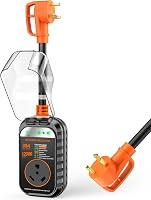
The Kohree 50 amp unit rates its surge protection at 14,000 joules. It absorbs high voltage spikes within 1 ns, according to Kohree, and covers air conditioners, refrigerators, water heaters, battery chargers and kitchen appliances.
Its circuit analyzer uses diagnostic LEDs to flag correct wiring, open ground, open neutral, reverse polarity, open hot, hot/ground reverse, and hot on neutral with hot open. The housing carries an IP67 rating, so it's built to shrug off rain, snow, wind and dust, and the waterproof cover is enlarged to fit most RV power plugs.
Ergonomic grip handles and a right-angle male connector make it easier to plug and unplug safely. It's ETL listed and comes with a 1-year warranty.
That combination makes it a strong fit for a 50 amp fifth wheel or motorhome where you want surge capacity and a fast read on the pedestal. The seven LED conditions cover the common wiring mistakes you meet at campgrounds.
For a 50 amp rig that also needs voltage and frequency management, our RV EMS surge protector roundup lists units with those features. A plain surge protector and an EMS do different jobs, and some rigs benefit from both capabilities in one device.
Choose a 50 amp protector rated 14,000 joules or more with a circuit analyzer when your rig runs 50 amp service.
What about very high joule ratings like 18,000?
An 18,000 joule rating gives the most surge headroom of the three products here. It suits a 50 amp rig with a lot of electronics or a buyer who wants maximum capacity, as long as the unit also covers the basics.
The Vehiker 50 amp unit is rated at 18,000 joules. Vehiker says the thickened tinned copper core reduces overheating and energy loss, and the nickel-plated plugs resist corrosion in damp conditions.
Its high-capacity capacitor arrays are built to absorb intense surges without saturating. That matters because a standard capacitor can fill up and fail when a sudden high-energy surge hits.
It's a plug-and-play design with flame-retardant materials and a waterproof cover against rain, wind and sandstorms. The compatible device list covers air conditioners, coffee machines, fans, heaters, lamps, microwaves, refrigerators and televisions.
Vehiker backs it with a 36-month warranty. Where does the extra joule capacity help?
On a rig with a residential fridge, multiple TVs, computers and a big air conditioner load, more surge capacity means more reserve before the protector is spent. It also gives peace of mind in storm-prone areas.
The trade-off is that a joule number is not a fault analyzer. The Vehiker unit's feature list centers on surge absorption and weather protection rather than the wiring fault checks the Kohree unit spells out.
If reading pedestal conditions matters more to you than raw capacity, weigh that against the higher rating.
Pick 18,000 joules when you want maximum surge reserve on a 50 amp rig and the unit's other features cover your needs.
Why joule count is not the only number that matters
Joules describe surge absorption, but the amp rating, fault detection and weather sealing decide whether the protector is right for your rig. A big joule number on the wrong amp rating won't connect, and a high rating without diagnostics won't warn you about a bad outlet.
Start with the amp rating. A 30 amp protector and a 50 amp protector use different plugs, and forcing one onto the other needs an adapter that adds bulk and a failure point.
Buy the rating that matches your shore power cord.
What should you check before comparing joule numbers?
Check the amp rating and the plug type first, then look at the fault list. The EMS-PT30X covers 30 amps at 120 volts and checks over and under voltage, grounds, polarity and AC frequency.
The Kohree unit covers 50 amps and lists seven LED conditions, from open ground to reverse polarity. Then check the housing.
IP67 on the Kohree and the all-weather assembly on the EMS-PT30X are built for wet campgrounds. A unit left connected in rain needs that protection to keep working safely, and the Vehiker adds nickel-plated plugs to fight corrosion in damp conditions.
Finally, think about how you'll use it. A portable unit travels with you and plugs in at each pedestal.
A hardwired unit stays on the rig and is always in the circuit. Our guide on what an RV surge protector does explains the difference in daily use.
Buy by amp rating first, then fault detection, then weather sealing, and use joules to compare within that shortlist.
How to choose a joule rating for your camping style
Your camping style changes how much surge capacity earns its keep. Storm-prone areas and long stays reward higher joule ratings, while weekend trips at reliable hookups need less reserve.
If you camp mostly in developed campgrounds with modern pedestals, a 30 amp unit at about 1,790 joules gives you surge protection plus fault checks. The wiring is usually sound, so the diagnostics confirm what you expect and the surge rating handles the occasional spike.
If you chase storms or stay through summer thunderstorm season, the extra headroom of 14,000 or 18,000 joules makes more sense. Each surge uses some capacity, and a bigger reserve means fewer replacements over the years.
Full-timers who plug in at a new pedestal every week benefit most from fault detection. Every new outlet is a new wiring question, and LED diagnostics answer it in seconds.
That's why the 50 amp units here pair joule ratings with circuit analyzers. Boondockers and generator users see fewer grid surges but still face spikes when a generator starts or stops.
A moderate joule rating covers those events, and fault detection still matters when you plug into shore power occasionally. The equipment you run also sets your floor.
A 50 amp rig with two air conditioners, a water heater and a residential fridge draws far more than a small trailer with one AC and a microwave. Match the protector's capacity to that load, not to a number on a box.
Match the joule rating to your surge exposure and let fault detection cover the wiring risks wherever you plug in.
What joule rating should you buy?
Buy a protector rated for your amp service with a joule figure that leaves headroom for your gear. For most 30 amp rigs, the Progressive Industries EMS-PT30X at 1,790 joules is the pick.
It covers a 30 amp service and checks the pedestal for the faults that cause real damage. If you tow a small trailer to developed campgrounds, it also keeps things simple, because it matches your cord with no adapter.
For a 50 amp rig, choose between the Kohree at 14,000 joules for surge capacity plus a seven-condition circuit analyzer, or the Vehiker at 18,000 joules for the highest surge reserve and a 36-month warranty.
The Kohree unit's IP67 housing and diagnostic LEDs make it the more complete all-round choice for most 50 amp setups. The Vehiker suits a rig loaded with electronics or a camper who spends a lot of time in storm country, but you give up the listed fault lights to get that extra reserve.
So when you ask how many joules for an RV surge protector, the honest answer is: enough to match your amp service and your surge exposure. About 1,790 joules for 30 amp, and 14,000 to 18,000 joules for 50 amp.
Then read the fault detection before you decide.
Once it is on your cord, check the weather cover before each trip and watch the unit's indicators for signs that its protection has been used up.
Pick your amp rating, set your joule floor, and choose the unit that tells you the most about the outlet before you plug in.
Frequently asked questions
How many joules do I need for a 30 amp RV surge protector?
Aim for about 1,790 joules or more on a 30 amp rig. The Progressive Industries EMS-PT30X carries that rating, and 30 amp service runs at 120 volts and 3,600 watts, so you don't need 50 amp-sized joule numbers.
Check the fault detection too, since wiring faults cause many RV electrical problems.
Is a higher joule rating always better for an RV?
A higher joule rating means more surge energy capacity, but it doesn't cover wiring faults, low voltage or reverse polarity. A 14,000 joule protector with no circuit analyzer won't warn you about a miswired pedestal.
Match joules to your amp service and check what faults the unit detects.
Do RV surge protectors wear out over time?
Surge protection components absorb energy each time they divert a spike, so capacity falls as they do their job. A very high joule rating gives more headroom before replacement.
Progressive Industries includes a surge failure indicator on the EMS-PT30X so you can see when protection has been used up.
Does a 50 amp RV need more joules than a 30 amp RV?
Yes, as a general starting point. A 50 amp rig pulls more current and usually runs more high-draw appliances, so 14,000 joules or more gives useful headroom.
A 30 amp rig at 120 volts and 3,600 watts works well with about 1,790 joules when the unit also checks wiring faults.
What else matters besides joules for an RV surge protector?
The amp rating has to match your rig, and the fault detection matters more for daily safety. Look for open ground, open neutral, reverse polarity and low voltage detection.
A joule figure alone tells you about surge absorption, not about whether the pedestal is safe to plug into.
Can I use a 50 amp surge protector on a 30 amp RV?
Only with the right adapter, and it adds bulk without extra benefit. The protector's amp rating should match your rig's service so plugs connect directly.
A 30 amp unit like the EMS-PT30X fits a 30 amp cord and detects faults on that service.