Pure Sine Wave vs Modified Sine Wave Inverter for RVs: Which Is Better? (October 2026)
Choose a pure sine wave inverter for sensitive or inductive devices; consider modified sine wave for simple loads that are confirmed compatible. Check each device’s requirements and the inverter’s continuous output before you buy.
On this page (8 sections)
- Pure Sine Wave vs Modified Sine Wave Inverter for RVs
- Pure sine wave vs modified sine wave: what changes?
- Which devices are a better fit for pure sine wave?
- How do continuous and surge watts affect the choice?
- How do the 3 inverter options compare?
- What should you check before installing an RV inverter?
- Which inverter waveform should you choose for your RV?
- Related RV power guides
Pure Sine Wave vs Modified Sine Wave Inverter for RVs
Choose a pure sine wave inverter for sensitive or inductive devices; consider modified sine wave for simple loads confirmed compatible with it. In a pure sine wave vs modified sine wave inverter comparison, your device manuals and actual power needs matter more than the waveform label alone.
A pure sine wave output closely matches the AC waveform from utility power. Modified sine wave output uses a different waveform, and some devices may run poorly, make noise or fail to operate with it.
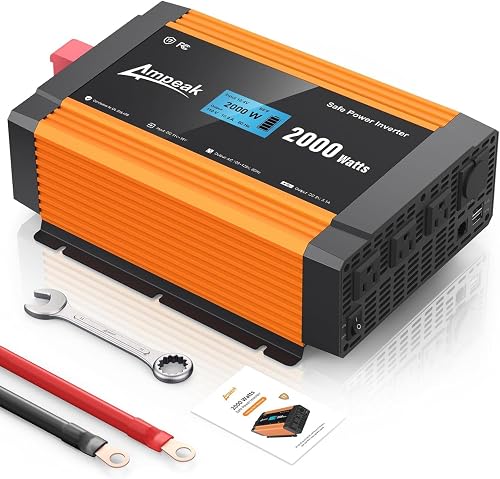
The BELTTT is a 2000W pure sine wave model. Ampeak and KRIEGER are 2000W modified sine wave models, each with a stated 4000W peak rating.

 Best for compatible basic loads
Ampeak 2000W Modified Sine Wave Inverter
Pure sine wave vs modified sine wave: what changes?
The main difference is the shape of the AC output, which can affect device compatibility. A pure sine wave is the closest match to typical utility AC, while a modified sine wave is a simpler stepped waveform.
That distinction matters for some electronics, motors and other inductive loads. The BELTTT is described as suitable for inductive and capacitive loads and for sensitive loads such as televisions and home theater equipment.
A modified sine wave inverter can still be suitable for compatible devices. Check the manual for each appliance before you connect it, especially if the appliance has a motor, transformer, timing control or electronic speed control.
Which inverter waveform does an RV need?
Choose by the devices you want to power, not by the RV label. RVs contain a mix of simple loads and electronics, and the required waveform can differ from one appliance to another.
Make a list of the devices you expect to use from the inverter. For each one, note its running watts, startup demand if it has a motor, and any waveform requirement in its manual.
If a manual calls for a pure sine wave, use a pure sine wave inverter. If it doesn't specify waveform compatibility, contact the manufacturer or choose a pure sine wave model to reduce uncertainty.
Which devices are a better fit for pure sine wave?
Pure sine wave is the more cautious choice for sensitive electronics and inductive loads. It can also help when you don't want to check compatibility separately for every device.
The BELTTT produces pure sine wave output and has a stated 2000W continuous rating with 4000W peak surge power. Its LCD displays input and output voltages, battery status and load status.
The display can help you notice changes in battery or load status, but it doesn't replace checking the manuals or sizing the battery and cables. Plan installation space too: the inverter measures 14.8 x 7.7 x 3.9 inches.
Can a modified sine wave inverter power a TV or laptop?
It may, but check the equipment manual before connecting it. A device's wattage rating does not tell you whether it accepts modified sine wave power.
Ampeak describes its inverter as suitable for electronics and small appliances, but compatibility depends on the exact device. Its output is modified sine wave, so treat the device manual as the deciding source.
The Ampeak has 3 AC outlets and 2 USB ports. Ampeak also says its efficiency is above 88% and recommends loads below 1760W after accounting for conversion efficiency.
How do continuous and surge watts affect the choice?
Match continuous watts to the load while it is running, and surge watts to any brief startup demand. A large peak number does not mean an inverter can supply that amount continuously.
All 3 models here are described as 2000W continuous in their product details. BELTTT and Ampeak list a 4000W peak or surge rating, and KRIEGER states 4000W peak power in its product description.
Add up the running watts of the devices you might use at the same time. For a compressor, pump or other motor load, check its startup requirement as well, then leave a margin rather than planning to operate at the inverter's limit.
For help choosing a capacity, see our guide to what size inverter you need for an RV. It can help you account for simultaneous loads and likely startup demand.
Can a 2000W inverter run an RV air conditioner?
You can't tell from the 2000W label alone. An air conditioner’s starting demand, the inverter’s surge duration and the battery system all affect whether it will start and keep running.
Look up the air conditioner’s running and startup figures, then compare them with the inverter’s continuous and surge limits. Also consider other loads that may be on at the same time.
A soft start can reduce startup demand on some RV air conditioners, but it doesn't guarantee compatibility with an inverter. Read our guide to running an RV air conditioner on battery power before planning an off-grid setup.
How do the 3 inverter options compare?
BELTTT is the pure sine wave choice; Ampeak and KRIEGER are modified sine wave options. The feature differences help narrow the choice, but the manuals for your loads should decide which waveform you need.
| Product | Best for | Waveform | Continuous output | Peak surge | Our score |
|---|---|---|---|---|---|
| BELTTT 2000W Pure Sine Inverter | sensitive devices | Pure sine wave | 2000W | 4000W | 8.7 |
| Ampeak 2000W Modified Sine Wave Inverter | compatible basic loads | Modified sine wave | 2000W | 7.4 | |
| KRIEGER 2000W Modified Sine Wave Inverter | a wired remote | Modified sine wave | 2000W | 7.2 |
The BELTTT includes a remote controller with a 23 ft cable and an LCD. Ampeak also has an LCD, along with a soft start and 17 stated safety protections.
KRIEGER includes a wired remote, an ANL fuse kit and 3 ft battery cables. Its LCD shows input voltage, output wattage and battery level.
What should you check before installing an RV inverter?
Check battery voltage, battery capacity, cable requirements, ventilation and mounting space before installation. These are 12V DC inverters, and their high output can draw substantial current from the battery system.
At 2000W output, a 12V system must supply far more than 2000 watts of DC input once conversion losses are included. Follow the inverter manual for cable size, fuse protection, ventilation and mounting instructions, or have a qualified RV technician handle the installation.
Battery capacity determines how long you can run loads. Our guide to sizing an RV lithium battery can help you estimate capacity from your planned use.
Don't assume the inverter will power every outlet or appliance in the RV by itself. The installation method and wiring determine what it can supply, and shore power or the RV generator may be needed for larger loads.
Which inverter waveform should you choose for your RV?
Choose pure sine wave when device compatibility is uncertain or a manual requires it; choose modified sine wave only when your planned loads are confirmed compatible. Then compare continuous watts, startup surge, battery needs and installation requirements.
The BELTTT is the pick here for sensitive or inductive devices and has a 2000W continuous rating. Ampeak and KRIEGER suit buyers whose loads accept modified sine wave power and who prefer their included features, such as Ampeak’s USB ports or KRIEGER’s wired remote.
Before settling on an inverter size, estimate your simultaneous loads and battery runtime. Our guide to how many batteries a 3000W inverter needs explains how inverter demand and battery capacity fit together.
Related RV power guides
- What size inverter do you need for your RV?
- Can you run an RV air conditioner on battery power?
- What size lithium battery does your RV need?
- How many batteries does a 3000W inverter need?
Frequently asked questions
Is pure sine wave better for an RV?
Pure sine wave is the safer default when you need to power sensitive electronics, inductive loads or devices whose manuals call for a utility-like AC waveform. It does not make every appliance compatible automatically, so check the device’s input requirements and the inverter’s continuous and surge ratings.
Can I use a modified sine wave inverter in an RV?
Yes, if each device you plan to run is confirmed compatible with modified sine wave power and stays within the inverter’s limits. Read appliance manuals, account for startup surges and avoid assuming that a device will work just because its wattage is below the inverter’s headline rating.
Will a 2000W inverter run an RV air conditioner?
A 2000W rating alone cannot confirm that an RV air conditioner will run. Check the air conditioner’s running and startup power, the inverter’s continuous and surge capacity, battery supply and wiring.
A soft start may affect startup demand, but it does not replace checking those ratings.
Does a pure sine wave inverter use less battery power?
Not necessarily. Battery use depends on the load, inverter efficiency, idle draw and the DC system.
Compare those figures for the exact models and plan for the current a 12V inverter draws at high output; battery capacity and cable sizing also matter.


