Why Use a RV Surge Protector?
Use an RV surge protector to stop bad campground power before it reaches your rig's electronics. It checks the pedestal for dangerous conditions, cuts power when voltage swings too far, and absorbs surge energy that would otherwise hit your appliances.
On this page (8 sections)
- Why use a RV surge protector instead of trusting the pedestal?
- What electrical hazards does it actually address?
- How does surge protection differ from an EMS?
- Can a surge protector prevent damage from bad campground power?
- Which type fits your rig: portable or hardwired?
- What should you check when you plug in?
- What a protector won't do for you
- So, why use a RV surge protector on every trip?
Use an RV surge protector to stop bad campground power before it reaches your rig's electronics. It checks the pedestal for dangerous conditions, cuts power when voltage swings too far, and absorbs surge energy that would otherwise hit your appliances.
The reason is simple: the power source changes every time you plug in. Your rig's breaker panel protects the wiring inside the coach, but it doesn't screen what arrives from the pedestal.
That's where a protector earns its place in your setup.
Why use a RV surge protector instead of trusting the pedestal?
Campground pedestals fail in ways your coach can't see. A worn outlet, a bad neutral, or a miswired box can send the wrong voltage into your rig the moment you connect.
Outlets at busy campgrounds get plugged and unplugged all season. Contacts loosen, moisture gets in, and breakers get replaced by whoever is on site.
The pedestal can look fine and still be wired wrong.
A protector checks the outlet before it lets power through. On the Progressive Industries units, that means testing for open ground and neutral, reverse polarity, and accidental 240 V on a 30 Amp outlet.
You find out at the pedestal, not when a converter starts smoking.
That's the plain answer to why use a RV surge protector: it moves the risk to a device you can replace instead of the appliances you can't.
What electrical hazards does it actually address?
A protector covers the problems that cause most RV electrical damage: surges, high voltage, low voltage, and miswired outlets. Each one stresses a different part of your system.
Surges are brief energy spikes. The Progressive Industries EMS-PT50X is rated to absorb up to 3,580 joules, and the EMS-PT30X up to 1,790 joules.
That energy goes into the protector instead of your wiring.
Overvoltage arrives when a pedestal or transformer sends more than the rig expects. A protector that monitors voltage disconnects the coach when the reading goes too high.
Undervoltage is the quieter hazard. Low voltage makes motors work harder and run hotter, which shortens the life of air conditioners and other compressor loads.
A protector that shuts off on low voltage removes that strain.
Wiring faults are the fourth group. Reversed polarity, an open ground, or an open neutral can put current where it shouldn't go.
The protector blocks power until the fault is fixed. Our explainer on what does an rv surge protector do walks through each check in detail.
How does surge protection differ from an EMS?
A surge protector absorbs spike energy; an EMS adds voltage monitoring and a shutoff. Most RV units sold as surge protectors include some EMS features, so the names blur in practice.
The difference matters when you compare models. A basic surge strip may only clamp spikes.
The Progressive Industries units add fault detection and AC frequency monitoring, and the Power Watchdog PWD50EPO analyzes power and shuts off when voltage drops below 104 V or rises above 132 V.
If you want the full protection set in one device, look for a unit described as an EMS. Our roundup of the best rv ems surge protector options covers what each model monitors and how fast it reacts.
Can a surge protector prevent damage from bad campground power?
It can prevent a large share of the damage, not all of it. The protector takes the hit from surges and refuses to pass power during unsafe voltage or wiring conditions.
What it can't do is fix the campground's wiring. If the pedestal is miswired, the protector keeps your rig safe by staying open.
You still need the campground to repair the site or move you.
It also won't stop every event. A direct lightning strike or a massive grid surge can exceed any protector's rating.
In those cases the unit may sacrifice itself, which is why a surge failure indicator or a replaceable surge module is worth having.
Think of it as a cheap part standing in front of expensive parts. A protector costs far less than a converter, a fridge control board, or an air conditioner.
Which type fits your rig: portable or hardwired?
Portable units plug in at the pedestal and go with you; hardwired units mount inside the coach. The choice comes down to how you camp and how much you want to carry.
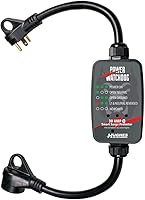
A portable protector, like the Progressive Industries EMS-PT50X or the Power Watchdog PWD50EPO, connects between the pedestal and your shore cord. You can move it to a new site or a new rig.
The trade-off is one more item to store and lock up.
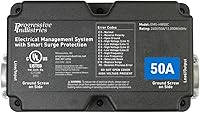
A hardwired protector lives in the coach's electrical bay. It's always there and can't be left behind.
It also can't be swapped to a different rig without rewiring. Our guide to the hardwired rv surge protector picks covers the install-friendly models.
If you move between rigs or rent RVs, portable makes more sense. If you keep one coach for years and want set-and-forget protection, hardwired is the cleaner fit.
Which protector suits a 50 Amp coach?
A 50 Amp coach with two air conditioners has the most to lose from a bad pedestal. The Power Watchdog PWD50EPO is the best fit for most 50 Amp owners, with 6,100 joules of surge protection, a 4-second power-on analysis, and Bluetooth monitoring of voltage, amperage, and wattage on your phone.
The Progressive Industries EMS-PT50X is the alternative for 50 Amp rigs. It's rated for 120-240 V and 12,000 W with 3,580 joules, and its all weather shield and Lexan housing are built for outdoor pedestals.
Its display and LED indicators show error codes and electrical status, so you can read a fault without opening an app.
Which protector suits a 30 Amp rig?
A 30 Amp travel trailer or Class C needs a protector rated for that service. The Progressive Industries EMS-PT30X is the best fit for most 30 Amp owners, rated for 30 A and 120 V with 1,790 joules and a 3,600 W capacity.
It catches the fault that hurts 30 Amp rigs most: a pedestal wired for 240 V. It also checks open ground and neutral, reverse polarity, and AC frequency.
Plug it in, read the display, and connect only when it clears.
Which protector gives you the most information?
The Power Watchdog PWD50EPO is the pick if you want to see what's happening. The free app shows voltage, amperage, and wattage in real time, and LED park power diagnostics plus wireless fault alerts tell you when the pedestal is misbehaving.
The EMS-PT50X also reports faults, but through its own display and LED indicators rather than a phone. Both let you diagnose a problem at the pedestal before you call the office.
What should you check when you plug in?
Read the protector's display or app before you connect the coach. A pass means the pedestal cleared its checks; a fault code tells you what's wrong.
Start with the outlet type. A 50 Amp pedestal uses a different receptacle than a 30 Amp one, and an adapter changes what the protector can test.
Match the protector to the rig's service first.
Then look at the reading. High or low voltage at the pedestal is the campground's problem, so ask for a different site rather than pushing through.
Wiring faults are the same story.
If the unit trips after you've connected, don't assume the protector is broken. Our guide to why does my rv surge protector keep tripping covers the common causes, from a weak pedestal to a fault inside the coach.
What a protector won't do for you
It won't boost low voltage, replace a generator, or fix a worn shore cord. It's a safety layer, not a power supply.
Some campers expect a protector to keep the air conditioner running through a brownout. A good unit does the opposite: it cuts power so the compressor doesn't run on bad voltage.
It also doesn't remove the need for a properly rated cord, a working breaker panel, and good connections. A protector sits in front of those parts and reports on what it finds.
Keep the housing dry and the connections clean. A protector left in a puddle or plugged into a cracked outlet isn't protecting anything.
Treat the unit as outdoor equipment and it will do its job.
So, why use a RV surge protector on every trip?
Use one because the pedestal is the one part of your electrical system you don't control. A protector tests it, blocks faults, and absorbs surges for a fraction of what a failed appliance costs.
The decision rule is short. Pick a portable EMS if you move between rigs or sites, and a hardwired unit if you keep one coach.
Match the amperage to your shore service: 50 Amp for a two-air-conditioner coach, 30 Amp for a smaller trailer.
If you're still deciding between models, start with our comparison of the best rv ems surge protector picks. For a fixed install, the hardwired rv surge protector guide covers mounting options.
Either way, plug in the protector first. The few seconds it takes to read the display is the cheapest insurance your rig will ever get.
Frequently asked questions
What is the difference between a surge protector and an EMS?
A surge protector's core job is absorbing spike energy. An electrical management system adds voltage and wiring checks, plus a shutoff when power falls outside safe limits.
Many RV units combine both in one housing.
Do I still need a protector if my RV has its own breaker panel?
Yes. Your breaker panel protects the wiring inside the coach from overloads and shorts.
It doesn't screen the power coming in from the pedestal, and it doesn't absorb surge energy before it reaches the panel.
Can a protector save my air conditioner from a brownout?
Low voltage makes motors such as air conditioners draw more current and run hotter. A protector that cuts power on undervoltage removes that stress before a long brownout turns into a burned-out compressor.
Will a surge protector fix a pedestal that is already miswired?
No. It detects the fault and refuses to pass power through.
That keeps reversed polarity or a bad ground away from your rig, but the real fix is asking the campground to repair or move you to another site.
How long does a surge protector last?
There is no set lifespan. Units with a surge failure indicator or a replaceable surge module tell you when the protection layer has taken a hit, so you can replace the part or the unit before the next trip.