30 Amp vs 50 Amp RV Service: What Is the Difference? (October 2026)
A 50 amp RV service can supply more power than a 30 amp service, but your RV determines how much you can use. Match the pedestal connection and any adapter to your RV's electrical service.
On this page (7 sections)
- 30 amp vs 50 amp RV service: what is the power difference?
- Which RV service lets you run more appliances?
- Can a 30 amp RV plug into a 50 amp pedestal?
- Can a 50 amp RV use a 30 amp pedestal?
- Should you choose a 30 amp or 50 amp surge protector?
- How do you decide which service your RV needs?
- 30 amp vs 50 amp RV service: which should you choose?
A 50 amp RV service can supply more power than a 30 amp service, but your RV determines how much you can use. Match the pedestal connection and any adapter to your RV's electrical service.
A 30 amp RV connection supplies up to 3,600 watts at 120 volts. A typical 50 amp RV service uses 2 separate 120 volt legs, allowing up to 12,000 watts total when both are available.
That extra capacity can let you run more high-demand appliances at once. It does not make a 30 amp RV into a 50 amp RV, even if you connect it to a 50 amp pedestal with an adapter.

30 amp vs 50 amp RV service: what is the power difference?
A typical 50 amp RV service can provide about 3 times the total power of a 30 amp service. The key difference is that the 50 amp connection has 2 hot legs, each carrying up to 50 amps at 120 volts.
For a 30 amp service, the calculation is 30 amps × 120 volts, or 3,600 watts. For a 50 amp service, it is 50 amps × 120 volts × 2 legs, or 12,000 watts.
Those are maximum figures for a suitable supply. Your RV wiring, appliances and campground power conditions affect what you can actually draw.
What does the 50 amp connection provide?
A common 50 amp RV connection has 2 hot wires, a neutral and a ground. Each hot wire supplies 120 volts to the RV, while the 2 legs measure 240 volts between them.
Most RV appliances use 120 volts from one hot leg to neutral. The RV's electrical panel distributes loads across the legs, so capacity depends on how the rig is wired and what is running.
Don't assume that a 50 amp connection means all appliances use 240 volts. Check your owner's manual or have a qualified electrician assess the setup if you're unsure how your RV handles shore power.
Why does a 30 amp RV have less capacity?
A 30 amp RV connection has one hot leg, one neutral and one ground. With 120 volts and a 30 amp limit, it has up to 3,600 watts available.
That supply can be enough for a smaller RV or a modest load. Running an air conditioner, microwave and other high-draw appliances together may exceed the available capacity.
Our guide to how many amps an RV uses explains common appliance loads. Check the appliance labels and your RV manual to understand how quickly those loads add up.
Which RV service lets you run more appliances?
A 50 amp RV generally gives you more room to run multiple high-demand appliances at the same time. A 30 amp RV requires closer attention to which appliances are on together.
The service rating sets a limit, not a guarantee that every appliance can run at once. Air conditioners, electric water heaters and microwaves can each use a large share of a 30 amp supply.
When is 30 amp service enough?
A 30 amp connection may suit your RV if your electrical loads are modest or you can stagger appliance use. For example, you may need to turn off the electric water heater while using a microwave and air conditioner.
The exact load depends on the appliances in your RV. Check your manual and appliance labels rather than relying on a rule of thumb.
If you frequently trip a breaker, the cause could be too many appliances running at once, a wiring problem or a campground supply issue. Our guide explains why an RV surge protector may keep tripping.
When is 50 amp service useful?
A 50 amp RV connection can be useful for a larger rig with multiple air conditioners or other high-draw equipment. Its two legs provide more total capacity than a 30 amp connection, though the RV's design still sets the limits.
You can still use a 50 amp RV at some campgrounds with only 30 amp service, using the correct adapter. Expect to manage loads as if you had the lower capacity available.
Can a 30 amp RV plug into a 50 amp pedestal?
Yes, a 30 amp RV can connect to a compatible 50 amp pedestal with a 50 to 30 amp adapter. The adapter changes the connection type, but the RV remains limited to 30 amp service.
The Manshan adapter has a NEMA 14-50P male end for a 50 amp pedestal and a TT-30R female end for a 30 amp RV cord. Its 10/3 gauge copper wiring and 125 volt, 3,750 watt rating match the adapter's role in connecting those two plug types.
Use the adapter only when the pedestal and your RV's cord match its connectors. It doesn't add capacity to the RV, so use the same appliance limits you would at a 30 amp outlet.
If a campground offers a 30 amp outlet, that direct connection is often simpler than using an adapter. For more on the cord side of the setup, see what size extension cord a 30 amp RV needs.
Can a 50 amp RV use a 30 amp pedestal?
A 50 amp RV may connect to a 30 amp pedestal with a suitable adapter, but the available supply drops to the pedestal's 30 amp limit. That can restrict how many appliances you run at once.
Adapters for this direction have different ends than a 50 to 30 amp adapter. Confirm that the exact adapter is designed for your RV cord and the campground outlet, and follow the RV manual.
The electrical load still needs to stay within the available circuit capacity. If the RV's main breaker trips, switch off appliances before resetting it, and stop if the equipment appears damaged or overheated.
Should you choose a 30 amp or 50 amp surge protector?
Choose a surge protector with the same amp rating as your RV's shore power connection. A 30 amp RV needs a 30 amp protector; a 50 amp RV needs a 50 amp model.
A protector's amp rating refers to the service connection it fits. It doesn't increase the campground supply or the RV's capacity.
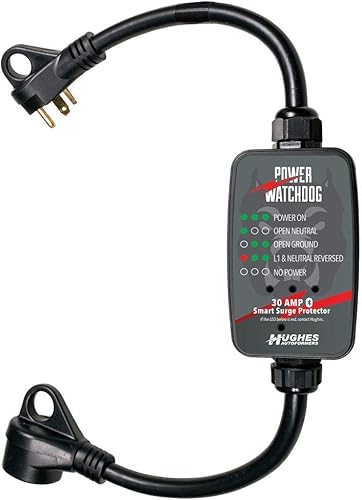
The PWD30 offers 3,000 joules of surge protection and LED park power diagnostics. The PWD50EPO offers 6,100 joules, LED diagnostics and a shutoff feature for an emergency.
A surge protector and an EMS can help identify or respond to certain power problems, but neither replaces correct wiring or safe load management. Our plain-words RV surge protector guide covers the main features to compare.
How do you decide which service your RV needs?
Use the service rating shown on your RV's shore power cord, inlet or owner's manual. Choose adapters and protection equipment to match that rating.
A large plug with 4 prongs often indicates a 50 amp RV connection, while a smaller 3-prong TT-30 connection is used for 30 amp service. Plug shape can help you identify the connection, but verify the RV's manual before buying equipment.
If your RV is 30 amp, a 50 amp pedestal can be useful when the campground has no 30 amp outlet, as long as you have a compatible adapter. Your RV still has the 30 amp limit.
If your RV is 50 amp, a 50 amp site gives it more available capacity. At a 30 amp site, plan to reduce loads and use a suitable adapter.
For a 50 amp RV, compare the best 50 amp RV surge protectors by service rating and features. Choose the 30 amp version if your RV has a 30 amp connection.
30 amp vs 50 amp RV service: which should you choose?
Choose 30 amp service if your RV is wired for 30 amps; choose 50 amp service if it is wired for 50 amps and you want access to its higher capacity. Match every connection device to the RV and campground outlet.
A 50 amp pedestal can serve a 30 amp RV through a correctly matched adapter, but the rig stays limited to 30 amps. A 30 amp pedestal can also limit a 50 amp RV when used with a suitable adapter.
For protection equipment, start with your RV's shore power rating and compare models made for that connection. The 30 amp vs 50 amp RV surge protector guide explains why the ratings matter.
Frequently asked questions
Is 50 amp RV service twice as powerful as 30 amp?
A typical 50 amp RV service has 2 hot legs, each at 50 amps and 120 volts, for up to 12,000 watts when both legs are used. A 30 amp RV service has one 30 amp, 120 volt leg, or up to 3,600 watts.
Actual use depends on the RV and campground supply.
Can a 30 amp RV use a 50 amp campground outlet?
A 30 amp RV can connect to a 50 amp pedestal with a correctly rated 50 to 30 amp adapter, when the pedestal has a compatible outlet. The adapter does not change the RV's wiring or raise its 30 amp limit, so manage appliances within that capacity.
Can a 50 amp RV use a 30 amp pedestal?
A 50 amp RV may connect to a 30 amp pedestal with the correct adapter, if the connection and equipment are suitable. The available supply is then limited by the 30 amp circuit, so you may need to switch off appliances to avoid overloading it.
Does a 50 amp RV always use 240 volts?
A common 50 amp RV connection has two 120 volt hot legs, a neutral and a ground. Although the legs measure 240 volts between them, RV appliances generally use 120 volts from one hot leg to neutral.
Check your RV's wiring and manual before making assumptions.
How do I choose an RV surge protector?
Choose a protector rated for the RV's actual service: 30 amp for a 30 amp RV or 50 amp for a 50 amp RV. For more context on service types and protection features, see our RV surge protector guide.